
Table of Contents
The AI GTM blueprint is the system architecture separating B2B founders who scale pipeline from those who stall in 2026. The shift from AI-assisted to AI-executed go-to-market is no longer a prediction. ZoomInfo’s 2026 GTM benchmark shows sellers who partner with AI hit quota 3.7 times more often than those working without it. B2B companies running AI-executed motions report 36% faster deal cycles according to HatHawk’s 2026 research. This guide breaks down the exact 3-layer framework, the implementation timeline, and the tool stack that makes it work.
However, most B2B founders are still running a fundamentally manual GTM motion with AI bolted on top. That approach creates a ceiling that effort alone cannot break through. This framework removes that ceiling by restructuring the entire motion around AI execution rather than AI assistance.
Why AI-Assisted GTM Is No Longer Enough
AI-assisted GTM puts a layer of intelligence on top of an existing manual process. A smarter email tool. A lead scoring model. A research assistant that speeds up what a human was already doing. The human still decides, routes, and pushes every step forward.
In contrast, AI-executed GTM removes the human from the execution layer entirely. The system qualifies, sequences, and adapts without waiting on a person to push the next button. Human judgment gets applied at the moments it creates the most value, not at every administrative handoff.
The market data confirms the gap is compounding. According to ZoomInfo’s 2026 GTM benchmark, the 3.7x quota attainment gap between AI-partnered sellers and manual sellers is not closing. It is widening every quarter. The AI SDR market hit $4.1 billion in 2025 and is projected to reach $15 billion by 2030.
Furthermore, Aurasell launched an AI-native GTM operating system in April 2026. Users on the platform are running 56% more sales cycles with zero headcount increase. This is not a productivity story. It is a systems architecture story. The framework codifies the same structural advantage into a framework any B2B founder can build.
The Before and After: Manual GTM vs AI-Executed GTM
The transformation is measurable across every metric that matters to a B2B founder building pipeline.
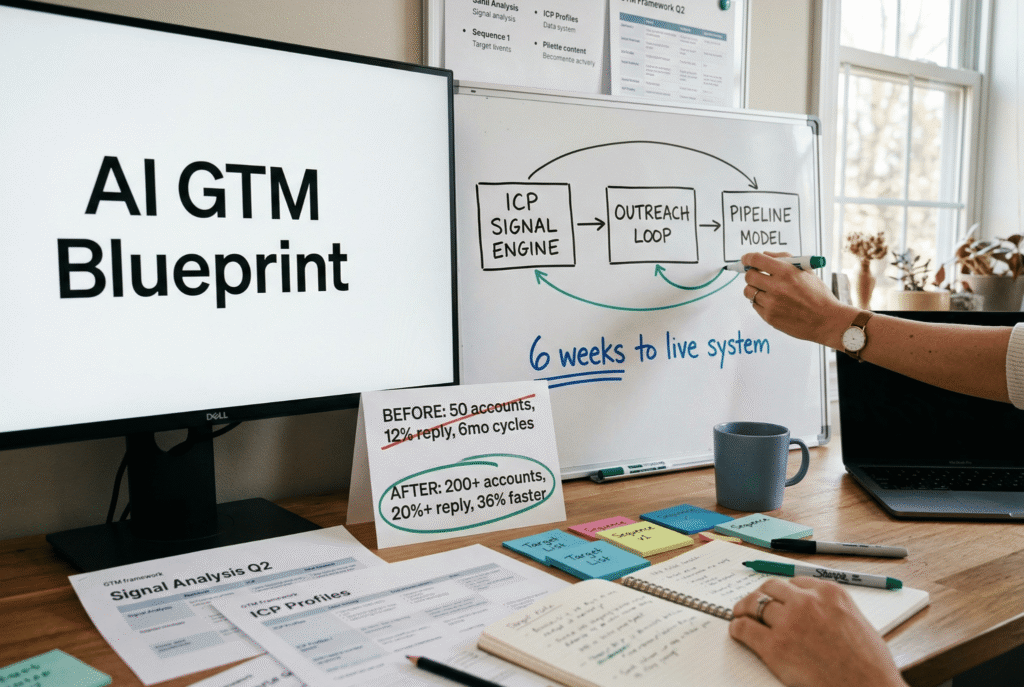
Before the framework: One or two people manage outreach manually. The ICP lives in a static spreadsheet refreshed once a quarter. Outreach sequences fire on preset timers regardless of prospect behavior. The CRM logs activity but never directs it. Each rep manages 50 to 80 accounts. Reply rates hover between 8% and 12%. Sales cycles stretch to 6 months. The pipeline stalls every time someone takes a day off or shifts focus.
After the framework: The system handles qualification, routing, sequencing, and follow-up automatically. Each rep manages 200+ accounts with AI handling execution. Reply rates climb above 20% because outreach adapts to each prospect’s engagement pattern. Deal cycles compress by 36% because signals trigger action in real time instead of waiting for a human to notice them. The pipeline runs 24/7 whether anyone is online or not.
As a result, the founder’s role shifts from pushing the GTM motion forward manually to designing the system and making high-leverage decisions. The operational ceiling disappears because growth no longer scales linearly with headcount.
The 3-Layer AI GTM Blueprint: How It Works
Each layer in this system builds on the one before it. Data flows automatically between layers. The system executes. The founder reviews and decides.
Layer 1: Live ICP Signal Engine. Replace the static ICP document with a dynamic signal detection system. Tools like Clay and Apollo monitor trigger events in real time: funding announcements, leadership changes, hiring surges, technology stack shifts, and intent signals. When a qualified trigger fires, the system scores the account against your ICP criteria and routes it into the outreach pipeline automatically. For example, a Series A announcement from a company matching your firmographic criteria generates a scored lead in minutes, not days. The ICP becomes a live feed that tells the system who to pursue right now.
Layer 2: Self-Adjusting Outreach Loop. Replace preset sequences with an AI feedback loop. The system reads reply signals, open rates, click patterns, and timing data. It adjusts messaging angles, send times, and follow-up cadence based on what is actually converting. AI generates personalized variations from enrichment data, producing custom angles per prospect based on company stage, role, and recent activity. Furthermore, the outreach loop improves itself with every cycle. Each batch performs better than the last because the system learns from real engagement data, not assumptions.
Layer 3: Intelligent Pipeline Model. Replace CRM views with predictive pipeline intelligence. AI analyzes deal velocity, engagement frequency, response sentiment, and historical conversion patterns. Consequently, it surfaces three actionable outputs: which deals need immediate human attention, which deals are progressing on their own and should not be interrupted, and where friction is building before it becomes visible in the numbers. Human judgment goes to relationship moments: late-stage calls, complex objections, strategic account decisions. Everything else runs on the system.
Therefore, the system as a whole runs between human touchpoints, not because of them. HatHawk’s 2026 research confirms that B2B companies with this architecture close deals 36% faster than manual teams. The advantage compounds every quarter the system runs.
Implementation Timeline: Build the AI GTM Blueprint in 6 Weeks
Building the full 3-layer system does not require a six-month project or a dedicated engineering team. Here is the implementation sequence that works for early-stage B2B founders.
Weeks 1 and 2: Build the ICP Signal Engine. Set up Clay or Apollo as the enrichment backbone. Define your ICP scoring criteria with specific firmographic, behavioral, and trigger-event parameters. Connect at least three signal sources: funding databases, job posting monitors, and technology tracking. Run your first batch of 100 accounts through the system. Compare the output quality and speed against your current manual process.
Weeks 3 and 4: Build the Outreach Loop. Connect your enrichment output to an AI drafting workflow using Claude or a similar tool. Generate personalized sequences from enrichment data. Set up the feedback mechanism: reply tracking, engagement scoring, and automatic variation triggers. In addition, configure Make.com or Zapier to route warm signals to your outreach tool and cold signals to a nurture track.
Weeks 5 and 6: Build the Pipeline Model. Connect your CRM to the signal engine and outreach loop so data flows without manual entry. Set up automated stage transitions based on engagement triggers. As a result, build the predictive layer: configure alerts for deals that show declining engagement, deals that need follow-up within 48 hours, and deals ready for a human touchpoint.
Consequently, the full system is live within 6 weeks. The first measurable results typically appear in weeks 3 and 4 when the outreach loop starts generating replies at a higher rate than the previous manual process. Gartner projects 30% of enterprises will deploy agentic AI in production by end of 2026, and the early-stage founders who build now will have a compounding advantage by Q4.
The Tool Stack Behind the Blueprint
The system runs on tools most B2B founders already have access to. The key is how they connect, not which specific products you choose.
For the ICP Signal Engine: Clay for multi-source enrichment, Apollo for contact data and verified emails, or similar enrichment tools. The critical requirement is real-time trigger monitoring, not just static database lookups.
For the Outreach Loop: Claude or a similar AI for personalized drafting from enrichment data. Smartlead, Instantly, or Apollo sequences for delivery. Make.com or Zapier for the feedback routing logic.
For the Pipeline Model: HubSpot, Pipedrive, or Monday.com CRM with automated stage triggers. For example, the predictive layer can start with simple time-based and engagement-based rules, then graduate to more sophisticated AI scoring as the system collects data.
In addition, the total tool cost for this stack runs $500 to $2,000 per month for an early-stage B2B team. That is less than the monthly cost of one junior SDR. The leverage is not marginal. It is structural.
What Your GTM Week Looks Like After Implementation
Monday morning: 30 new scored leads are already in your outreach pipeline from signals that fired over the weekend. Outreach sequences are running. Your CRM shows updated deal stages from the previous week’s engagement data.
Furthermore, you spend 30 minutes reviewing outreach performance data and approving the next batch of personalized sequences. Another 20 minutes on the three deals the pipeline model flagged for human attention. The rest of the day is strategic work: client calls, product decisions, partnership conversations.
By Friday, 150+ new prospects have been contacted with personalized outreach. Your reply rate data is feeding back into the outreach loop for next week’s improvement. Warm leads have been routed to your calendar automatically. You did not manually research a single lead, write a single cold email from scratch, or drag a single deal card across a pipeline view.
This is what AI-executed GTM looks like when the system runs the motion and you run the strategy.
At Lumeneze, the approach to building these systems starts with mapping the exact human bottlenecks in your current GTM motion, then designing the 3-layer AI GTM blueprint around your specific market, ICP, and sales process. The goal is a live system within 6 weeks.
The gap between AI-native GTM teams and manual teams is compounding every quarter. It will not close on its own. The time to build the system is now.
Book a 15-minute call to see how the blueprint applies to your GTM motion: calendly.com/ashikurrahaman/quick-intro