

Table of Contents
An agent ready product strategy is no longer a future consideration for B2B teams. It is the most urgent product decision of 2026. Shopify just shipped an AI Toolkit that lets external agents run entire stores through natural language. No dashboard. No clicks. Just structured API calls that read inventory, update products, and deploy code changes in real time. Gartner predicts 40% of enterprise applications will embed task-specific AI agents by 2026, up from less than 5% in 2025. The shift is here.
Why Agent Ready Product Strategy Matters Now
For most of the SaaS era, product teams designed for one user: a human sitting at a screen. Every feature, every workflow, every onboarding flow assumed someone would click, scroll, and navigate. That assumption is breaking.
In addition, the rise of AI agents like Claude Code, OpenAI Codex, and Cursor means your product’s next power user may never see your interface. These agents interact through APIs, not dashboards. They read structured data, execute commands, and validate results programmatically.
Furthermore, the growth rate is staggering. An 8x increase in agent-embedded applications within a single year signals that this is not an experiment. It is a platform shift. B2B companies that ignore it will find their products bypassed by competitors whose systems work seamlessly with autonomous tools.
As a result, product roadmaps need a new column. Not “AI features.” Not “chatbot integration.” A dedicated agent interface layer that treats AI systems as first-class users of your product.
What Shopify’s AI Toolkit Reveals About Product Design
Shopify’s approach is worth studying because they did not bolt a chatbot onto their existing UI. They built agent-ready infrastructure from the ground up. The AI Toolkit ships with 16 distinct agent skills covering inventory management, product updates, SEO optimization, and code deployment.
For example, the shopify-admin-execution skill lets agents make real changes to a live store through natural language commands. The agent does not simulate clicking buttons. It calls validated API endpoints directly, with full schema documentation and code validation built in.
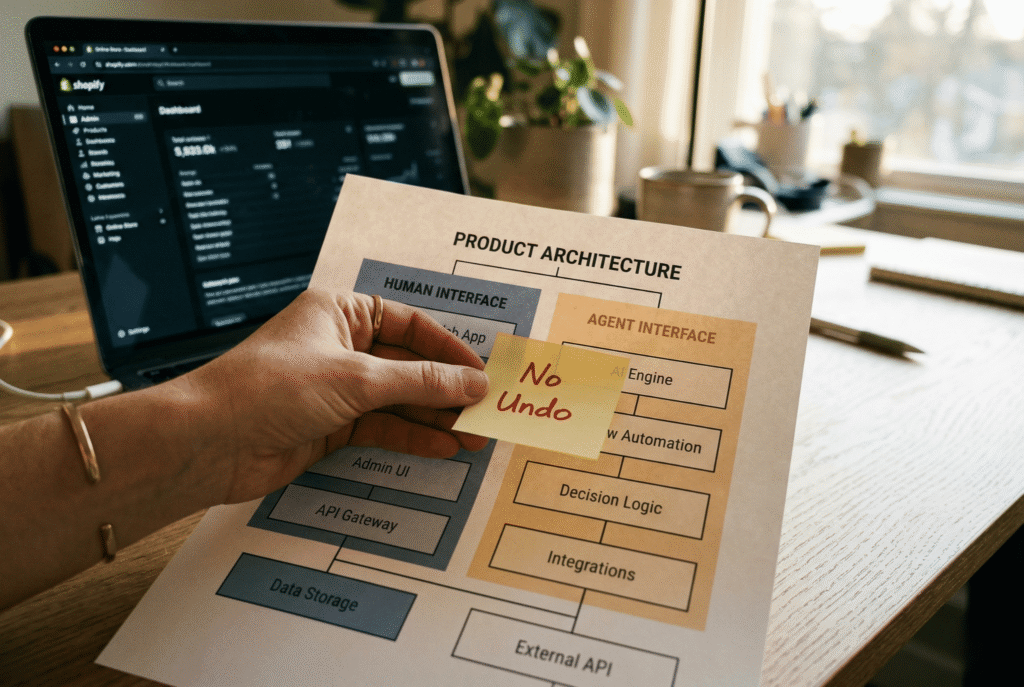
However, the most telling detail is what Shopify did not ship: an undo button. There is no version history. No rollback system. No trash can for agent-initiated changes. This reveals the frontier of agent ready product strategy. Giving agents access is the easy part. Building the trust and safety layer is where the real product work lives.
Therefore, the lesson is not “copy Shopify.” It is “look at what they prioritized and what they left out.” Execution came first. Safety infrastructure is still catching up. Your product can learn from both decisions.
The Two-Interface Framework for B2B Products
Every B2B product now needs two interfaces. One for humans. One for agents. These are not the same thing, and treating them as interchangeable is a common mistake that weakens your agent ready product strategy.
The human interface is what you already have. Dashboards, forms, navigation, visual feedback. It is optimized for comprehension and decision-making.
In contrast, the agent interface is a structured API layer optimized for execution. It needs clear schemas, explicit permissions, validation rules, and predictable responses. Agents do not browse. They call endpoints. They need to know exactly what is possible, what data format to use, and what response to expect.
Consequently, your product architecture should address these four layers:
- Discovery: can an agent understand what your product does and what actions are available?
- Authentication: can an agent securely connect and maintain permissions?
- Execution: can an agent perform real actions through structured API calls?
- Validation: can an agent verify that its actions succeeded and handle errors gracefully?
Most B2B products today cover the first two layers. The companies that will dominate the next cycle are the ones that ship robust execution and validation layers this year.
Building Trust Infrastructure for Agent Execution
Shopify’s missing undo button is not a bug. It is a signal. The hardest part of any agent ready product strategy is not access. It is trust.
For example, when an agent updates 500 product descriptions in a single batch, who reviews the changes? When an agent deploys a code modification to a live store, what happens if the change breaks checkout? These are product problems, not AI problems.
Furthermore, trust infrastructure includes several components that most B2B products have not built yet. Audit trails that log every agent action with full context. Approval workflows that let humans review high-risk actions before execution. Rate limits and scope boundaries that prevent agents from exceeding their intended authority. Rollback mechanisms that can reverse agent-initiated changes cleanly.
The companies that solve this problem will define the next generation of B2B platforms. At Lumeneze, we help B2B teams build exactly this kind of systems infrastructure into their product and GTM operations.
How to Start Your Agent Ready Product Strategy Today
You do not need to rebuild your product from scratch. Start with an audit. Map every core workflow in your product and answer one question: can an AI agent perform this action through a structured API call today?
As a result of this audit, you will likely find that most of your high-value workflows still require a human to navigate a UI. That gap is your opportunity.
In addition, prioritize the workflows that agents would use most frequently. Data retrieval, status updates, bulk operations, and configuration changes are the highest-value targets. These are the actions that agents perform well and humans find tedious.
Therefore, the first step is not “build an AI feature.” It is “make your product’s core actions API-accessible with clear schemas and validation.” That foundation serves both human integrations and agent integrations. It is the most leveraged investment a product team can make in 2026.
The product teams that move on this now will own the agent integration cycle. The ones that wait will spend 2027 playing catch-up while their competitors’ products work seamlessly with every major AI system on the market.