
Table of Contents
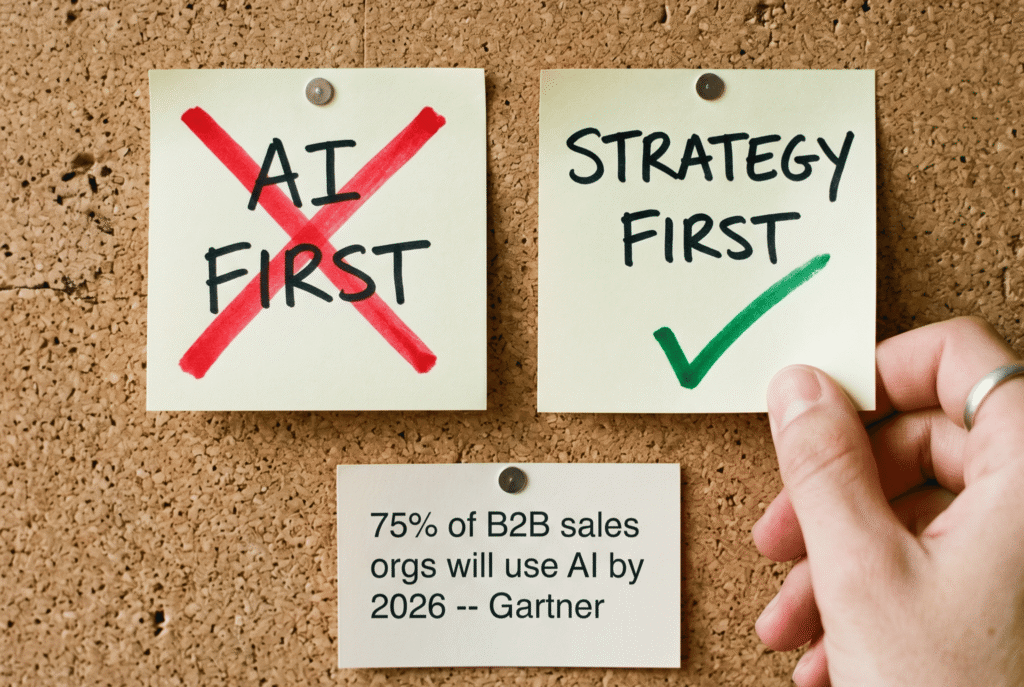
A well-built AI GTM strategy is the defining competitive advantage in B2B sales right now. Gartner projects that 75% of B2B sales organizations will use AI tools by 2026. However, most of those teams will generate more activity, not more pipeline. The reason is almost never the tool. It is the go-to-market foundation underneath it. Without a clear ICP, a mapped buyer journey, and messaging matched to buyer reality, AI has nothing precise to execute against.
On April 14, 2026, Demandbase launched Demandbase AI at their annual GO London conference. CEO Gabe Rogol summarised the core principle in one sentence: “AI without context creates noise.” That observation is the clearest description of why most B2B teams are investing in AI automation and still not seeing pipeline results.
Why AI GTM Strategy Is Underdelivering for Most B2B Teams
The most common failure pattern looks like this. A founder or sales leader invests in an AI outreach platform, runs it for 60 to 90 days, and watches reply rates fall while volume climbs. They blame the tool. The tool is not the problem.
AI is a multiplier. It scales whatever is already in the system. As a result, if that system contains a vague ICP, generic messaging, and a buyer journey that was never mapped in detail, AI scales all of that at higher speed. The noise gets louder, not quieter. More emails go out. Fewer conversations start. The team burns sender reputation with each sequence that misses.
Most AI GTM strategy failures are not AI failures. They are GTM failures that AI made visible faster. The intervention point is not the tool. It is the foundation that AI is being asked to execute against. Building a better prompt does not fix a poorly defined ICP. Upgrading to a more sophisticated sequencing platform does not fix messaging that does not match where the buyer is in the journey.
Furthermore, the cost of getting this wrong is rising. Every personalised email that misses, every outbound sequence that generates no replies, and every intent signal acted on with the wrong message trains the buyer to ignore future outreach. AI-powered misalignment scales the relationship damage along with the volume.
The 3-Layer GTM Foundation AI Needs to Execute
Before any AI tool can produce consistent pipeline, three layers need to be defined with precision. These are not conceptual frameworks. They are operating inputs that AI requires to make decisions at scale.
Layer 1: ICP at the account and persona level. Most teams define their ICP at the segment level: Series A SaaS companies in North America with 10 to 50 employees. That is a market segment, not an ICP. For AI to know who to target, it needs buying triggers. What specific event or condition signals that a company is ready to buy right now? A new executive hire in a relevant role, a recent funding round, a specific tool in their tech stack, or a job posting that signals a particular internal initiative? Without buying triggers, AI targets everyone and converts no one.
Layer 2: Buyer journey with stage definitions. AI cannot personalise outreach if it does not know where the buyer sits in the journey. In contrast to a generic three-stage funnel, each stage of your actual buyer journey needs an entry signal and an exit goal. What indicates that a buyer entered this stage? What action moves them to the next one? Without those definitions, AI sends the same message to a cold prospect and a warm champion, and both respond poorly.
Layer 3: Messaging matched to buyer reality. The most expensive mistake in GTM is messaging built around what the seller wants to say rather than what the buyer needs to hear. Each persona carries a specific pain, uses specific language to describe it, and holds a specific objection to moving forward. For example, a VP of Sales and a Founder at the same company have completely different frames for the same operational problem. AI needs both versions to write outreach that feels personally relevant to each.
Context Intelligence: What Demandbase Got Right
Demandbase’s new AI platform is built around what they call Context Intelligence. The concept is that each company’s AI layer is trained on that company’s specific GTM context: their pipeline goals, their account signals, and their historical performance data. This allows AI to filter intent signals, prioritise accounts, and coordinate actions across sales, marketing, and advertising in a way that untrained, generic AI cannot.
The lesson for B2B teams not running an enterprise platform is the same. The GTM context must exist before AI can use it. Therefore, the teams that see the best results from AI GTM tools in 2026 are not the ones with the largest toolstacks. They are the ones who defined the operating foundation first and then deployed AI on top of it as the execution layer.
This is why early-stage B2B teams sometimes outperform larger competitors with bigger budgets. A 10-person team with a precise ICP, a mapped buyer journey, and messaging tested against real conversations will consistently outperform a 100-person team running sophisticated AI tools on a vague GTM foundation.
How to Audit Your GTM Foundation Before Adding AI
Use these four questions as a foundation audit before adding or expanding AI tooling. If any cannot be answered clearly and specifically, that layer needs work first.
- Question 1: Can you name the three most reliable buying triggers for your ICP? Not industry or company size, but the specific event or condition that signals a company is ready to buy right now.
- Question 2: Can you describe your buyer journey in three to five stages, each with a specific entry signal and a clear exit goal?
- Question 3: For each persona you target, can you write one sentence describing their core problem from their perspective, in the language they use?
- Question 4: Does every piece of outreach messaging map to a specific stage and persona, or does the same message go to every contact on the list?
If those four questions have clear, specific answers, AI can execute effectively on top of that foundation. Consequently, adding AI tools at that point is likely to produce measurable pipeline results within 30 to 60 days. If those questions cannot be answered with precision, adding more AI will accelerate confusion rather than resolve it.
The AI GTM Playbook: What to Do This Quarter
Building a reliable AI GTM strategy does not require a large team or a sophisticated platform. It requires clarity in three layers, then precision in execution. Here is a practical sequence for this quarter.
Step 1: Run the four-question audit and document the gaps. Be specific about which layer is weakest. Most teams find that the ICP definition is at the segment level when it needs to be at the trigger level.
Step 2: Run a two-week sprint to define the weakest layer. Use data from existing deals if available. Talk to five current customers and ask them to describe the problem they were trying to solve before hiring you, and what made them decide to move. Their words become your messaging.
Step 3: Deploy AI in the layer with the clearest definition first. In addition to targeting, this might mean starting with AI-assisted qualification or intent-signal filtering before adding AI personalisation to outreach copy. Build from the strongest foundation outward.
Step 4: Measure at the stage level, not just the outcome level. Track reply rate by segment, meeting rate by sequence, and conversion rate by stage. AI can only improve what is being measured with enough granularity to act on.
Step 5: Review and refine every 30 days. A strong AI GTM strategy is a feedback loop, not a one-time setup. The more precisely the context is defined and updated, the better AI executes over time. Teams that build structured review cycles into their AI GTM operation consistently outperform those running AI on a set-and-forget basis.
At Lumeneze, this foundational work comes before a single automation is built. GTM clarity first. AI execution second. That sequence produces pipeline instead of noise.
If you are running AI outreach and not seeing pipeline, the issue is almost certainly a foundation gap. Book a 15-minute strategy call with Ashikur at calendly.com/ashikurrahaman/lumeneze to audit your GTM foundation together.