
Table of Contents
B2B AI marketing orchestration is the difference between a funnel that looks healthy and one that actually closes revenue. According to Demand Gen Report’s 2026 B2B Trends research, 43% of B2B marketers say their campaigns appear successful but fail to translate into actual sales. The dashboards are green. The pipeline is full. The close column is empty.
This is not a tools problem. Most B2B teams in 2026 have deployed AI across every funnel layer. The problem is that each tool runs in isolation, generating signals that no other tool receives. This guide breaks down why the disconnect happens and how to fix it with a connected AI system.
The B2B AI Tools Trap: Green Metrics, Empty Closings
For most B2B teams, the AI stack looks impressive on paper. There is an intent data platform flagging in-market accounts. There is a scoring model classifying leads by fit. There is an email automation tool sending personalized sequences. There is a CRM tracking every interaction. And yet revenue growth has stalled.
The cause is structural. Each tool does its job in isolation. The intent platform identifies a high-fit account, but that signal never reaches the scoring model. The scoring model fires a sequence, but the sequence tool has no idea what the account has already received. The rep opens the CRM and finds no context from any of the other layers. They show up cold to a conversation that should have been warm.
Furthermore, each tool reports its own success. Clicks, opens, form fills, pipeline stages. None of these metrics connect to each other. As a result, the stack looks like it is working, right up until someone checks the revenue line.
This is the AI tools trap. And 43% of B2B marketers are inside it right now.
What B2B AI Marketing Orchestration Actually Means
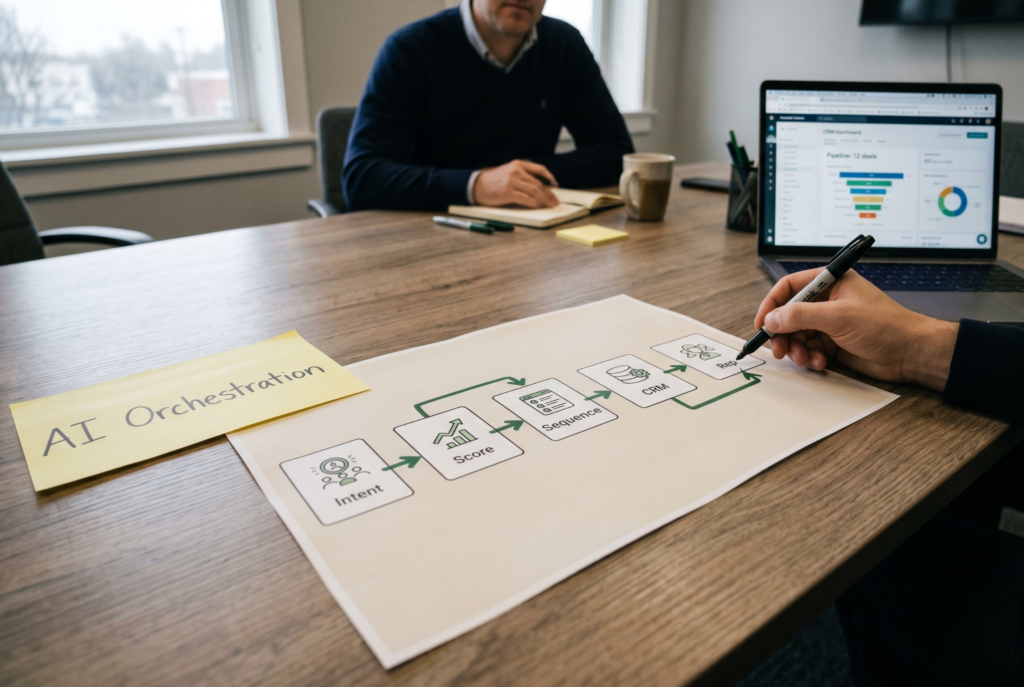
B2B AI marketing orchestration is the practice of connecting AI-powered tools into a unified system where every layer passes context to the next. Instead of isolated tools running parallel workflows, orchestration creates a chain. Each agent’s output becomes the next agent’s input.
In practice, this means the intent signal from your data platform feeds directly into your scoring model. The scoring model’s output triggers the sequence platform with context: which persona, which pain point, which stage of consideration. The sequence platform passes engagement signals back to the CRM. The CRM uses that enriched record to route the rep and surface the right talk track at the right moment.
For example, consider what happens when a target account visits your pricing page three times in a week. In an isolated stack, that signal sits in your analytics tool. In an orchestrated system, that signal updates the lead score, triggers a personalized follow-up sequence referencing the pricing page visits, enriches the CRM note, and alerts the rep with a suggested opening message. All of this happens without a single manual step.
This is not science fiction. The technical infrastructure to build these systems exists today. What most teams are missing is the architecture decision to connect them.
How to Build a Connected AI Funnel in 2026
Building a connected AI funnel starts with mapping your current context gaps. Before adding any new tools, audit the handoffs between the ones you already have.
Step one is identifying every point in your funnel where a signal is generated but not passed downstream. For each tool, ask: what data does this tool produce, and where does that data go next? If the answer is nowhere, or a spreadsheet, you have found a gap.
Step two is prioritizing the highest-value gap. In most B2B funnels, the most costly gap sits between intent signals and CRM records. High-fit accounts are showing buying signals that no rep ever sees. Fix this gap first.
Step three is building the bridge. This may mean a native integration, an automation layer using tools like Clay or Zapier, or a purpose-built AI agent. The goal is that a signal produced in one tool becomes enriched context in the next tool within minutes, not days.
Step four is closing the loop with the CRM. Every engagement signal across every tool should land in the CRM record. Not as a log entry. As a structured enrichment that the rep can read in thirty seconds and act on immediately.
Therefore, the connected funnel is not about the number of tools. It is about the quality of the handoffs between them. A three-tool stack with clean context passing will outperform a ten-tool stack with isolated reporting every time.
The Competitive Window: Why This Matters Right Now
The urgency behind B2B AI marketing orchestration is structural. Gartner forecasts that 40% of enterprise applications will embed task-specific AI agents by end of 2026, up from less than 5% in 2025. This is a one-year window where the gap between orchestrated and isolated B2B funnels will become visible in market share.
In addition, Demand Gen Report’s 2026 B2B research found that 96% of B2B marketers already use AI in their roles. The baseline has shifted. AI tools are table stakes. The differentiator in 2026 is whether those tools are wired together or running as isolated units.
Companies that build connected AI systems now will compound their advantage through the second half of 2026 and into 2027. Their reps will always have context. Their sequences will always be relevant. Their scoring will always reflect current account behavior. Consequently, their pipeline conversion rates will separate from the market.
In contrast, teams waiting for the perfect tool or the perfect timing will enter Q4 2026 still stitching exports and importing CSVs, while competitors close deals with AI-generated context their tools surface automatically.
What to Do This Week
The practical starting point for B2B AI marketing orchestration is a context audit. This week, map every tool in your funnel and document every handoff. You do not need to fix everything at once. Find the single highest-value gap and build one connection.
If your intent data platform is not talking to your CRM, start there. If your email sequences are firing without CRM context, build that bridge. If your reps are showing up cold to conversations that generated multiple intent signals, that is the first bridge to build.
At Lumeneze, we help early-stage B2B startups build these connected systems from scratch. Not another tool recommendation. An architecture decision that changes what your funnel actually does with the signals it already has.
If you want to audit your current funnel and identify where the highest-value context gap is, book a 20-minute call: calendly.com/ashikurrahaman/lumeneze.