
Table of Contents
B2B AI agent context is the missing layer in most enterprise deployments today. Teams invest in capable models, clean data pipelines, and well-designed workflows, but the agents still produce outputs that feel disconnected from how the business actually operates. Decisions get drafted without understanding who owns them. Summaries miss the stakeholders that matter. Follow-up actions skip the relationship context that any experienced employee would know instinctively.
This week, Microsoft announced Work IQ APIs going generally available on June 16, 2026, building on the Microsoft IQ platform unveiled at Build 2026. It is one of the clearest signals yet that the enterprise AI industry has identified the organizational context gap and is moving to close it.
Therefore, for B2B product teams and growth leaders, this shift has direct implications for what you build, how you architect your agent workflows, and what competitive advantage looks like over the next twelve months.
Why B2B AI Agents Struggle Without Organizational Context
Enterprise AI has a performance paradox in 2026. The underlying models are more capable than ever. Structured data is more accessible than ever. However, enterprise buyers consistently report that AI tools do not deliver the expected productivity gains inside B2B workflows.
The gap is not computational. It is contextual.
B2B environments are fundamentally relationship-driven. A procurement decision involves multiple stakeholders across departments with different priorities and informal veto power. A strategic account requires knowing which contacts are engaged, which are cold, and what communication patterns predict forward motion. A complex onboarding has dependencies that live in people’s calendars and email threads, not in a CRM field.
Current AI agents can read the CRM. They cannot read the organization.
For example, Microsoft’s June 2026 Work IQ announcement frames the problem directly: agents need both trusted business data and organizational context to produce useful enterprise answers. Without the latter, they are operating on 10 percent of the information a human expert would use.
Consequently, B2B AI agent context is not a nice-to-have. It is the foundational layer that determines whether enterprise AI actually changes how work gets done, or stays a faster search bar.
What Microsoft Work IQ Delivers for B2B AI Agent Context
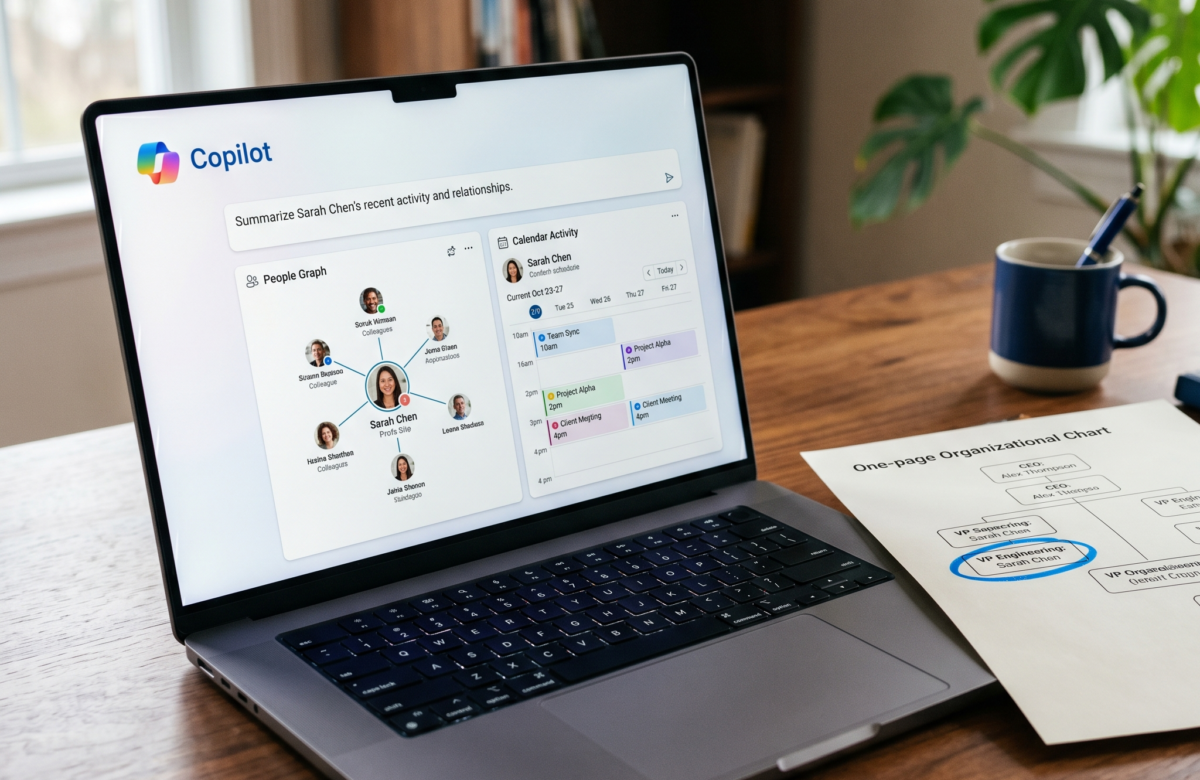
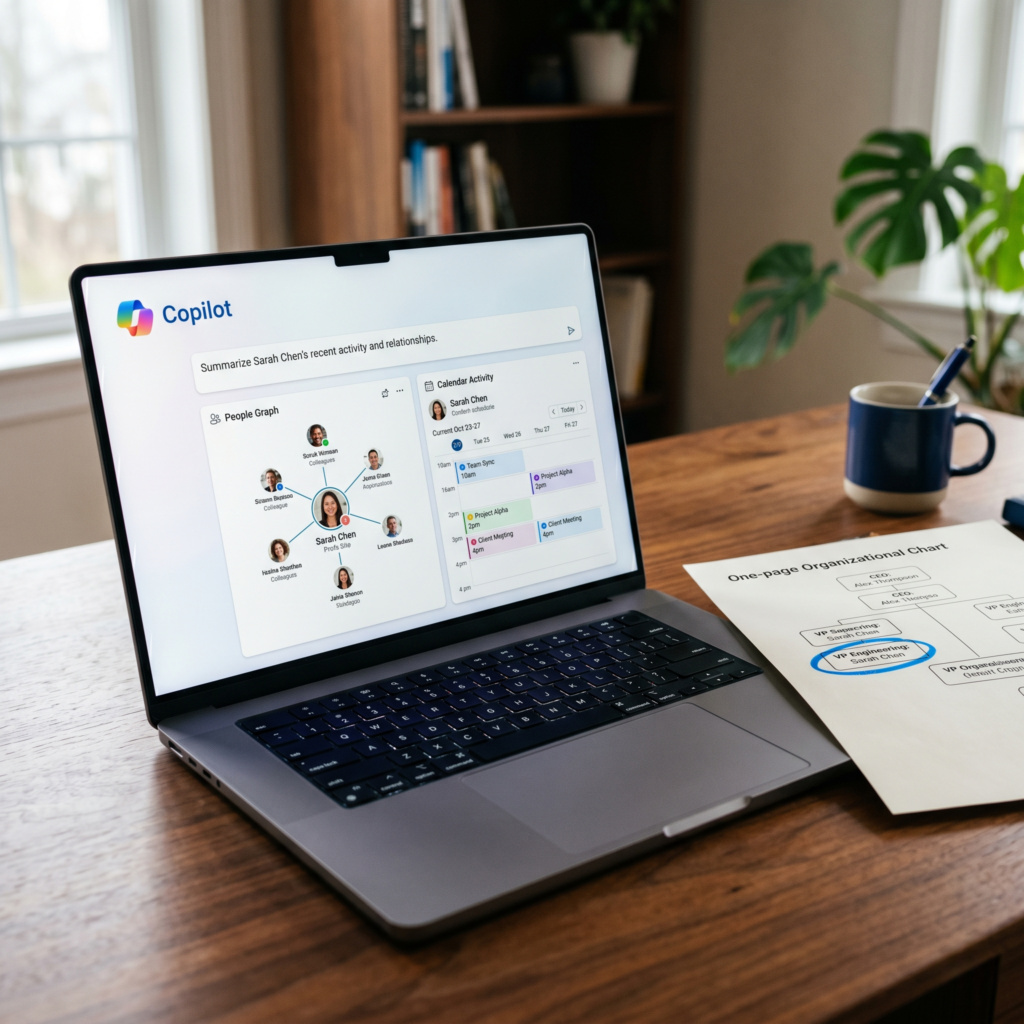
Work IQ is not an assistant and it does not have its own user interface. It is a context API that AI agents can query to understand how an organization actually operates, built on top of Microsoft 365 signals that already exist in most large enterprises.
Specifically, Work IQ surfaces four categories of organizational intelligence:
- People graphs: who works with whom, team structures, and active collaboration patterns across the organization
- Calendar intelligence: meeting patterns, recurring engagements, and scheduling signals that indicate relationship depth and project activity
- Document activity: which files are in motion, who is editing what, and what content is actively being worked on
- Communication flows: how information moves through the organization and who participates in which conversation threads
These signals come from Microsoft 365, the productivity suite at the center of most large enterprise organizations. Work IQ aggregates and structures them so that AI agents built in Copilot Studio, Microsoft Foundry, or any system using the Work IQ APIs can query organizational context without building fragile workarounds.
The APIs go generally available June 16 with three main integration paths: A2A (agent-to-agent), a redesigned remote MCP server, and a REST API. Billing runs through Copilot Credits, Microsoft’s unified consumption currency, with no separate subscription or per-user license required.
As a result, B2B AI agent context that previously required months of custom integration work is now available through a standard API. That changes the build equation considerably for product teams operating on Microsoft’s stack.
In B2B AI, Organizational Context Outweighs Model Capability
This is a counterintuitive point for most enterprise AI buyers in 2026. Most procurement discussions focus on model selection: which foundation model, which benchmark score, which context window size. However, the performance ceiling for an enterprise agent is not set by the model. It is set by the quality of the context the model receives.
An average model with excellent organizational context will outperform a frontier model working only with file-level inputs in most B2B workflows. B2B decisions are governed by relationships, org dynamics, and informal processes. A model that understands those inputs makes fundamentally better decisions than one that does not.
In addition, organizational context compounds over time. An agent that learns which stakeholders are active on a given account, which communication threads precede decisions, and which calendar patterns signal a deal moving forward becomes more valuable the longer it operates. That compounding effect is a durable competitive moat for B2B products that build on context layers early.
Furthermore, enterprise buyers are beginning to evaluate AI tools on organizational intelligence, not just task completion. The evaluation question has shifted from “can your AI draft this email” to “does your AI understand why this email matters and who it should come from.”
Therefore, B2B product teams that treat B2B AI agent context as infrastructure rather than a feature will build products that are defensible in ways that raw model capability cannot replicate. Models will commoditize. Organizational context, properly structured and maintained, will not.
How to Apply the B2B AI Agent Context Layer in Your Product
For teams evaluating whether and how to build on Work IQ or equivalent organizational context APIs, the practical path has three phases. Each phase builds on the one before it, so sequence matters.
Phase 1: Map your context gaps. Identify where your AI outputs are technically correct but contextually wrong. These are cases where the agent produced a reasonable answer but missed the organizational reality. Common examples include account summaries that ignore relationship history, follow-up drafts that miss the actual decision owner, and onboarding plans that skip the informal dependencies that experienced employees know instinctively.
Phase 2: Design context queries before agent actions. The most common mistake in enterprise AI agent design is starting with what the agent should do and working backward to what it needs. Instead, start with what organizational context is required to make a good decision and build the query layer first. Work IQ’s three API endpoints give you three integration paths depending on whether your agents operate peer-to-peer, tool-to-tool, or system-to-system.
Phase 3: Build a feedback loop on context quality. Organizational context is not static. Relationships change, projects shift, and communication patterns evolve week to week. Agents that treat organizational context as a fixed snapshot will degrade. Consequently, the advantage goes to teams that build context as a living layer, refreshed on a cadence that matches how the organization actually changes.
Lumeneze works with B2B product and growth teams to build AI-enabled systems that reflect how enterprises actually operate. The most common starting point is a systems audit: mapping where current AI outputs miss organizational reality and designing the context layer to close that gap.
Practical Takeaway for B2B Teams Building AI Products in 2026
The arrival of Work IQ APIs at general availability is not just a Microsoft product announcement. It is a market signal that organizational context is the next battleground for B2B AI agent performance. The infrastructure layer is now available. The window to build on it before competitors do is narrow.
Teams that move early will build B2B AI products that feel qualitatively different to enterprise users. An agent that understands your organization is not just a better tool. It is a different category of tool.
The practical action for June 2026 is straightforward. Audit your current AI agent’s context inputs. If the answer is documents, databases, and structured data, you are working with a fraction of the context your agents need. The organizational layer is now available. Build on it.
For technical detail on the Work IQ API, review Microsoft’s production-ready intelligence documentation. If your team is evaluating AI product strategy for the second half of 2026, book a strategy session with Lumeneze to map the context gaps in your current AI architecture and prioritize what to build next.