

Table of Contents
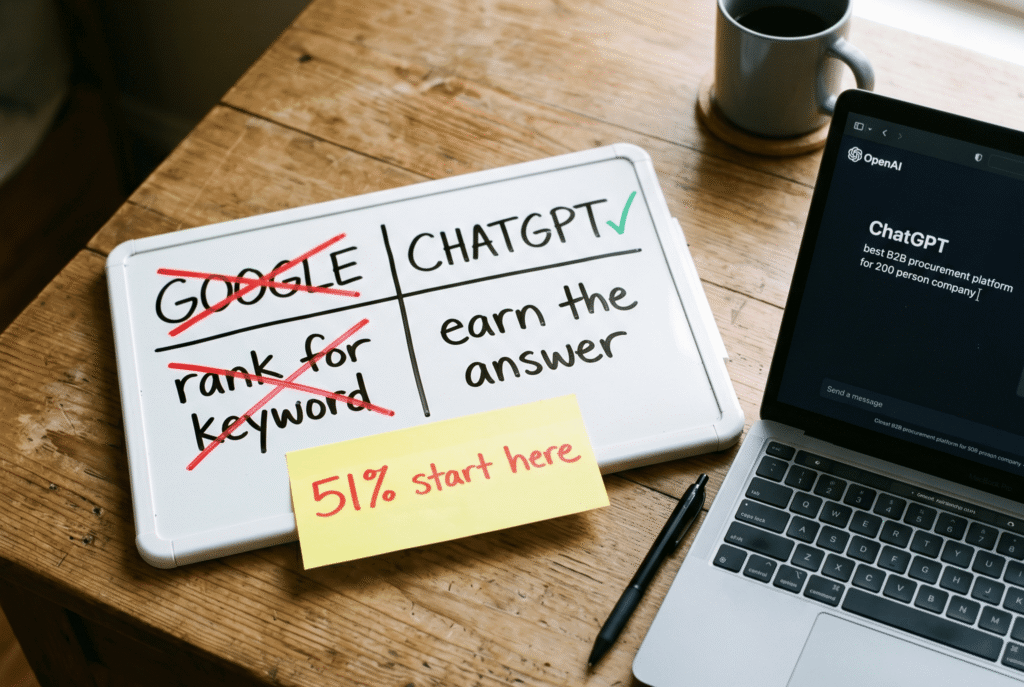
A B2B AI search strategy is no longer optional. As of March 2026, 51% of B2B software buyers begin vendor research inside an AI chatbot, not a search engine. Eleven months earlier the figure was 29%. The shortlist is now built by an answer engine before any human visits a homepage.
The shift is not subtle. G2 Answer Economy 2026 research, based on 1,076 buyers across North America, EMEA, and APAC, found that 71% of B2B software buyers picked a vendor different from the one they had originally planned to evaluate. One in three bought from a vendor they had never heard of before the chatbot mentioned them.
The shortlist has moved from Google to AI chatbots
For two decades the B2B inbound playbook ran on a simple loop. Rank for the category keyword. Capture the click. Convert the click into a form-fill. Hand the form-fill to sales.
However, that loop has a new gatekeeper. When a CFO asks ChatGPT for the best procurement platform for a 200-person company, the model returns three or four named vendors in a single paragraph. The buyer reads that paragraph, asks two follow-up questions, then opens a comparison page. Google never enters the journey.
As a result, the first impression is no longer the homepage. It is the model one-line summary of who you are. If your team cannot agree on that summary, the model will write one for you. The version it writes is rarely the version that converts.
What the G2 Answer Economy data tells founders
Three numbers from the G2 study are worth pinning to the wall.
- 51% start in an AI chatbot. Up from 29% in eleven months. The trend line is not flattening.
- 71% switched vendors based on AI guidance. The shortlist a buyer arrives with is not the shortlist they leave with.
- 53% find AI research more productive than search. Once a buyer experiences the speed of an answer engine, they do not return to scrolling ten blue links.
In addition, the AEO (Answer Engine Optimization) software category grew over 2000% on G2 in twelve months. The market for tools that help vendors get cited by AI is now a real budget line, not a fringe experiment.
Forrester named the same shift a few weeks later. Their GTM Singularity research, published April 27, calls for an ARC approach. Augmented, Resilient, Collaborative. The translation is straightforward. AI agents are now part of the GTM workforce, and buyer agents are now part of the buying committee.
A B2B AI search strategy that wins shortlists
A B2B AI search strategy starts with one uncomfortable question. If a target buyer asks ChatGPT, Claude, or Perplexity for the best vendor in your category right now, what does the model say?
For example, run the prompt yourself. Read the answer. Note who is named, in what order, and what one-line description the model attaches to each vendor. That paragraph is your real category positioning. Whatever your website says is now secondary.
Therefore, the strategic job has changed. It is no longer rank for the keyword. It is earn the recommendation. That requires a different kind of content, a different kind of distribution, and a different kind of measurement.
Four levers to pull this quarter
Most B2B teams do not need a six-month transformation program. The B2B AI search strategy that compounds is built from four specific moves executed cleanly.
1. Sharpen the one-sentence summary. Write the sentence you want the model to repeat about your company. Include who you serve, what specific outcome you deliver, and what makes you different. Then publish that sentence in five places: homepage, About page, LinkedIn company page, G2 profile, and the first line of every blog post.
2. Restructure existing content for parsing. Answer engines reward direct claims with proof. Rewrite your top ten pages so each opens with a clear thesis sentence, supports it with a specific data point and a named source, and uses subheadings that read like questions a buyer would type.
3. Concentrate third-party proof. Models trust review sites, comparison content, analyst mentions, and podcast appearances more than your own pages. For example, three new G2 reviews and one named podcast appearance shift AI citations faster than ten new blog posts.
4. Build an AI mention measurement loop. Once a week, run the same five buyer prompts in ChatGPT, Claude, and Perplexity. Log who gets named, in what order, and how you are described. The trend over four weeks is your real GTM dashboard.
Measuring AI-driven discovery before pipeline notices
Pipeline metrics will lag the shift by one or two quarters. Form-fills look stable until they do not. By the time MQLs drop, the model has already routed buyers to a competitor for several weeks.
Consequently, the leading indicator is not organic traffic. It is AI mention frequency, mention sentiment, and mention rank. A simple weekly log of how many times you appeared in the answer to your top ten buyer prompts will catch the leak earlier than any ad-platform dashboard.
In contrast, teams that wait for pipeline metrics to confirm the shift will spend two quarters confused. Then they will spend another two quarters trying to rebuild content for AI discovery while their competitors compound the lead.
A B2B AI search strategy is the bridge between the old inbound playbook and the new answer-engine economy. Built early, it compounds. Built late, it costs a year of pipeline.
Furthermore, if your team needs help auditing how AI engines describe your category and rebuilding content, positioning, and measurement for AI-first discovery, Lumeneze builds B2B GTM systems for early-stage founders who want to compound the next 18 months instead of catching up to them. Book a 15-minute intro at calendly.com/ashikurrahaman/quick-intro.