
Table of Contents
The AI agent foundation test is the four-question check that tells a B2B founder whether the team is ready to deploy an agent or whether the agent will simply scale a broken system. Three founder conversations in the last week pointed at the same trap. The team picks an agent before defining the system the agent operates inside. Output speeds up. Quality drops.
Why AI agents stall in B2B startups
In addition to the hype, the data shows a clear pattern. Deloitte and McKinsey research published in 2026 finds 86 percent of B2B leaders say their organizations are not ready to integrate AI into daily operations. Gartner projects 40 percent of agentic AI projects will be cancelled by 2027.
However, the driver is not technology cost. Skills and process gaps account for 68 percent of the barrier. Budget accounts for 14 percent. The bottleneck is no longer model access. It is system readiness.
For example, an autonomous outreach agent on top of a fuzzy ICP sends faster, not better. A scheduling agent on top of a messy CRM books the wrong meetings, faster. Speed without structure becomes amplified noise. The AI agent foundation test addresses this gap before a project ships, not after.
The AI agent foundation test, in four checks
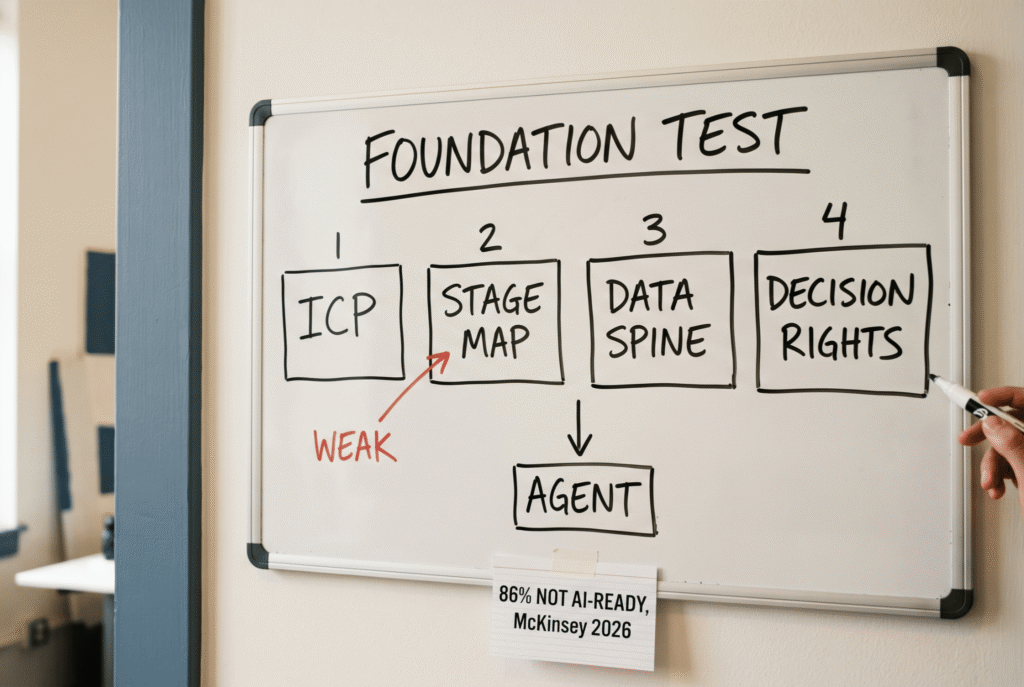
The AI agent foundation test runs four checks before any model goes into production. Each check protects a different layer of the system. Skip one, and the agent amplifies that broken layer. Pass all four, and the agent compounds the system underneath it.
- ICP sharpness in one sentence.
- Buyer-stage transitions observable in data.
- A single source of truth for accounts, contacts, and signals.
- Decision rights for every action the agent can take.
Furthermore, the order matters. Sharpness comes first because it shapes every decision after it. Decision rights come last because they only become real once the upstream layers exist.
ICP sharpness and stage transitions
ICP sharpness means one written sentence separates a buyer from noise. Not three paragraphs. Not a persona deck. One sentence the agent can act on.
For example, “mid-market SaaS in North America” gives an agent no signal. In contrast, “Series A B2B SaaS, 50 to 200 employees, sales-led GTM, hired a VP Sales in the last 90 days” gives the agent a working query.
Therefore, the second check, stage transitions, only works once the ICP is sharp. Stage transitions mean buyer-stage shifts must produce observable changes in your data layer. If a deal moves from “engaged” to “evaluating” and nothing in the system changes, the agent has no event to react to.
Consequently, a real transition shows up as data. The prospect downloads a security one-pager, books a second call, and adds a procurement contact. Each event is observable. The agent can route, sequence, or escalate. A made-up transition that lives only in a sales rep’s head is invisible to the agent and useless to the system.
Data spine and decision rights
In contrast to most agent guides, this framework treats data architecture as the third foundation, not the first. The data spine is one source of truth for accounts, contacts, and signals. If three systems disagree on whether a contact sits inside your TAM, the agent picks one and trains on the wrong reality.
A clean spine does not require a single platform. It requires one rule. Each entity has one canonical record, and every other system points to it. Without that rule, every agent action will eventually contradict another system’s view of the world.
Furthermore, decision rights are the fourth check and the one most teams ignore until something goes wrong. Decision rights mean every action the agent can take has a clear human owner. Sending an email, booking a meeting, escalating a support ticket, refunding a payment, or posting in a channel.
For each action, write down two answers. Who approves it. What signal triggers automatic execution without approval. If you cannot answer both, the agent either freezes on real work or fires unsafe actions on uncertain signals.
Install order: system first, agent second
As a result of running the AI agent foundation test on a dozen B2B engagements, the install order stays consistent. Tighten the ICP first. Make the stage map observable second. Build the data spine third. Document decision rights fourth. Deploy the agent fifth.
Most of 2025 was about access to AI. The infrastructure question is closed. Anyone can spin up a long-running agent this week. 2026 is about installation order. Teams that compound results sharpen the system underneath the agent first. Teams that lose ship faster versions of the same broken funnel.
Consequently, the AI agent foundation test is not a gate that slows projects down. It is the order that prevents rework. A two-week sharpness sprint saves a six-month rebuild after the agent ships into the wrong system.
Three things to do this week
To put the AI agent foundation test into practice this week, do three things and stop there. The point is sharpness, not breadth.
First, write the one-sentence ICP. Pass it to a colleague who has never seen your sales deck. If they cannot list five companies that match, the line is not sharp enough yet.
Second, map five recent buyer-stage transitions. For each one, list the observable event in your data layer. Any transition with no event stays invisible to an agent and should not be wired into automation.
Third, list the five actions the first agent will take. For each, name the approver and the auto-execute signal. Any action without both answers stays human-only until you can fill them in.
As a result, the work this week looks small but compounds fast. Pass these three, and the team is inside the safe zone for an agent project. Stay there before you pick a model.
For more on system design before automation, see Lumeneze’s approach to B2B growth systems. The principle is the same in both directions. Fix the system, then accelerate it.