

Table of Contents
The AI agents B2B product playbook just changed under everyone’s feet. In May 2026, SAP unveiled the Autonomous Enterprise at Sapphire with more than 200 specialized agents shipping inside one platform. Gartner forecasts 40% of enterprise applications will include task-specific AI agents by end of 2026, up from under 5% in 2025. For B2B founders still shipping “AI assistant” features, the buyer reference point has already moved.
However, this is not a story about catching up to SAP. It is a story about how enterprise buyers now evaluate every B2B product on the same axis: which workflow does your AI actually own, end to end. This guide walks through what changed, why it matters, and the practical playbook B2B product teams can apply this quarter.
The Quiet Shift In Enterprise Buying
For two years, enterprise buyers tolerated copilots. A sidebar that summarized a record. A chat box that drafted an email. A button that suggested a next step. The unspoken deal was simple: AI made existing workflows faster, humans still owned the decision.
In contrast, that deal expired in May 2026. Procurement committees, CFOs, and Chief AI Officers are now asking a sharper question. Not “does your product have AI” but “which workflow inside your product runs without my team touching it.” That single shift redraws the B2B product roadmap.
Therefore, the lens for evaluating any AI feature has changed. Sidebar copilots now read as table stakes. Buyers want decision rights handed to the agent, with the human reduced to exception handling. This is the new floor for credible enterprise AI.
What SAP Just Shipped At Sapphire 2026
At SAP Sapphire 2026, SAP introduced the Autonomous Enterprise vision built on a unified SAP Business AI Platform. The platform stitches SAP Business Technology Platform, SAP Business Data Cloud, and SAP Business AI into a single governed environment.
Furthermore, the SAP Autonomous Suite ships with more than 50 domain-specific Joule Assistants spanning finance, supply chain, procurement, human capital management, and customer experience. Those assistants orchestrate more than 200 specialized agents that execute precise tasks across end-to-end processes.
For example, the new Autonomous Close Assistant compresses the financial close process from weeks to days by automating journal entries, reconciliation, and error resolution across the entire flow. That is not a copilot. That is a workflow owner.
In addition, SAP brought in foundation-model partnerships across Anthropic, Mistral, and Cohere, plus interoperability with Google Cloud and Microsoft agent frameworks. The message to enterprise buyers is explicit. The autonomous suite is the new operating layer, not an add-on.
Gartner Forecast: 40% Of Enterprise Apps By Year End
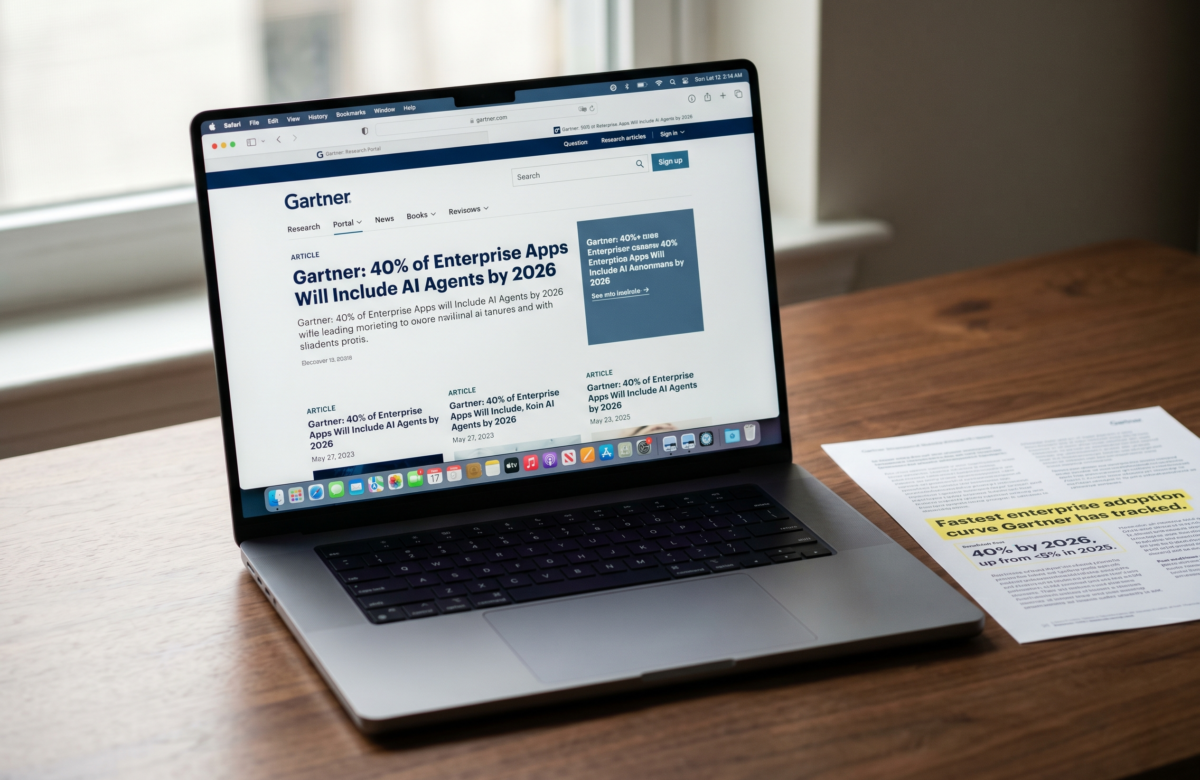
SAP is not an outlier. According to Gartner, summarised by Constellation Research, 40% of enterprise applications will include task-specific AI agents by the end of 2026. That number was under 5% just twelve months ago.
Consequently, every B2B product category now has a fast-mover playing for the agent category. CRM has it. ERP has it. Service has it. Procurement has it. The question is no longer whether agents arrive in your space. The question is whether your product is the one shipping them.
As a result, founders who treat AI as a feature instead of a workflow owner are now competing in a category that no longer exists in the buyer’s mind.
Furthermore, the procurement signal has shifted with the buying signal. Enterprise security and risk teams now ask vendors for agent guardrails, decision-rights documentation, and audit trails on autonomous actions. A B2B product that cannot answer those questions in a security review is no longer a finalist. The cost of operating without an agent strategy is no longer just a roadmap gap, it is an active sales loss every quarter.
The New AI Agents B2B Product Playbook
Five operating principles separate the AI agents B2B product winners from the copilot crowd.
- Pick a workflow, not a feature. Map one end-to-end business process inside your product (lead-to-qualified, ticket-to-resolved, invoice-to-close). The agent owns the full loop, not a step.
- Define decision rights, not UI. Specify what the agent can decide alone, what it escalates, and what it logs. That contract becomes your real product spec.
- Measure outcome compression. Track time saved, error rate, and headcount redirected. The Autonomous Close cuts weeks to days. Pick a metric a CFO can repeat in a board meeting.
- Build the exception path first. Agents fail in narrow ways. The credible product makes those failures visible, logged, and easy to override before scaling deployment.
- Price the agent, not the seat. Per-workflow, per-outcome, or per-agent pricing aligns the model with the value delivered. Seat-based pricing punishes the buyer for adopting agents that displace seats.
How To Pick Your First Workflow
In contrast to “ship AI everywhere,” the AI agents B2B product approach picks one painful, repeatable, rule-heavy workflow. The shortlist test is simple.
- Runs more than 50 times per month inside a typical customer account.
- Has clear inputs, clear outputs, and a finite decision tree.
- Currently consumes more than four hours of human time per run.
- Failure mode is recoverable, not catastrophic.
For example, lead qualification, support triage, expense categorization, contract redlining, and order reconciliation all meet that bar in most B2B platforms. The right first workflow is the one your team understands deeply enough to define decision rights without guessing.
Takeaway For Founders
Therefore, the AI agents B2B product question for the next two quarters is narrow. Which single workflow inside your product can run, decide, and report without a human in the loop. The answer redraws roadmap, pricing, and sales motion at the same time.
Consequently, the B2B founders who win this cycle are the ones who narrow scope before broadening it. One workflow shipped fully, with measurable outcome compression, builds the proof case for the next three. Founders who try to sprinkle agents across the product without owning a single loop end up with a marketing message and no defensible position. Pick the workflow, define decision rights, ship the loop, then expand.
Lumeneze helps early-stage B2B founders make that choice and ship the first agent without losing focus on the rest of the product. If that is the call your team is wrestling with right now, the Lumeneze advisory desk is the right next conversation.