
Table of Contents
The B2B funnel collapsed in 2026, and AI lead scoring sits at the center of what replaces it. In a market where 75% of pipeline decisions are now influenced by AI and 90% of buying is intermediated by AI agents, static scores no longer match the way buyers move. Furthermore, the gap between teams running modern AI lead scoring and teams running 2022 systems is now visible in revenue, not theory.
This guide breaks down the new architecture growth teams are using to replace the funnel, what AI lead scoring actually looks like in production, and how to rebuild your stack in 30 days.
Why the B2B Funnel Collapsed in 2026
The traditional funnel assumed buyers move through linear stages. They no longer do. In 2026, buyers move in bursts of high-intent signals, often jumping from awareness to evaluation in a single session. As a result, the question that drives growth is no longer “where in the funnel is this person.” The question is “what did this account just do, and what should fire in the next 15 minutes.”
Two macro shifts force the rebuild. First, AI agents now mediate most B2B research. Buyers ask a chatbot to shortlist vendors before a single human touch. Therefore, much of the activity a funnel was built to track now happens off your property. Second, the speed of buying decisions has compressed. A signal that was useful within 24 hours in 2022 is useless within 30 minutes in 2026.
Static lead scoring assumes time. Signal surge assumes speed. That gap is what closed the old funnel.
AI Lead Scoring vs Static Scoring: The 2026 Numbers
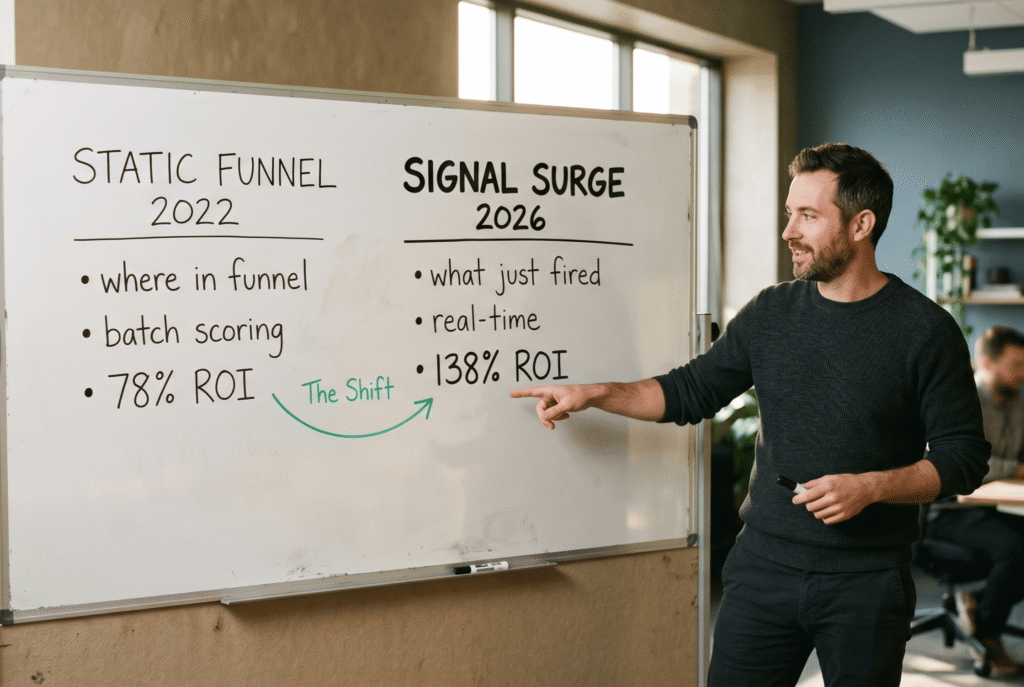
The performance gap is now wide enough to settle the architecture debate. Companies running AI lead scoring report 138% ROI on revenue programs. Companies running static manual scoring report 78%. In addition, accuracy of fit and intent prediction lands between 40% and 60% with AI scoring versus 15% to 25% with manual rules, according to research summarized by Warmly and reinforced by 2026 industry trend reports.
However, the bigger story is response time. AI lead scoring updates within 5 to 15 minutes of a signal firing. Batch scoring waits 24 hours. By the time a stale score updates, the buyer has already asked an AI agent for a recommendation and shortlisted three vendors.
Furthermore, pipeline contribution from AI-sourced engines now sits around 25% of total revenue at companies that built the stack early, with 200% or more quarter-over-quarter growth on AI-sourced opportunities. The numbers are not marketing copy. They are the gap between teams who rebuilt and teams who added AI on top of an old model.
The Three-Layer Signal Surge Architecture
The architecture replacing the funnel has three layers. Each layer has a different job, and each layer fails differently if it is missing.
Layer one: signal capture. This layer pulls behavioral and intent data from every channel the buyer touches. Pricing page revisits, demo video completion, third-party intent feeds, repeat product searches, and account-level surge across multiple users. In contrast to old models, behavioral signals carry 60% or more of total scoring weight, while firmographics drop to a supporting role.
Layer two: AI decisioning. This is where most stacks break. The AI layer reads patterns across signals, not single events. It distinguishes a one-time pricing visit from a real surge across three users in two hours. As a result, the system stops scoring people and starts scoring buying committees forming in real time.
Layer three: activation. This is the response library. Every signal pattern maps to one specific play, with one owner and one fire-by deadline. For example, a “pricing surge plus repeat demo view” pattern triggers a personalized video to the named buyer within 10 minutes, plus a Slack ping to the AE. Therefore, no signal sits in a queue waiting for human triage.
How to Rebuild Your AI Lead Scoring Stack in 30 Days
A full rebuild does not require a vendor change. It requires a sequence. Most teams own the data already. Few have wired it together. Use the following 30-day cadence to install AI lead scoring without breaking pipeline.
Days 1 to 7: signal taxonomy. List every behavioral and intent signal currently captured. Then list every signal you should be capturing but are not. Map each to a buying-stage hypothesis and a confidence weight. The output is a one-page table, not a deck.
Days 8 to 14: response library. For each signal pattern, write the exact response play. Channel, owner, message, deadline. Cap the library at 12 patterns in version one. In addition, kill any pattern that does not have a clear owner.
Days 15 to 21: AI decision layer. Wire an AI engine to read the signals and trigger the response plays. This can sit on top of your existing CRM, marketing automation, or data warehouse. The job is decisioning, not data movement.
Days 22 to 30: response window enforcement. Instrument the 5 to 15 minute fire-by deadline. Track signal-to-action latency as a top-line metric. Consequently, slow response becomes visible and fixable instead of buried in handoff queues.
For a deeper walk-through of how this fits into a full growth architecture, see the Lumeneze systems frameworks.
The Mistake Most Growth Teams Make
The common failure is adding AI on top of a 2022 model. Teams license a new scoring tool, plug it into the same nurture sequences, and expect compounded results. However, the underlying logic is still funnel-shaped. The AI gets faster at running an outdated playbook.
For example, a team installs AI lead scoring, sees scores update every 10 minutes, and still routes those scores into a five-day nurture sequence. The signal window closes long before the nurture finishes. Therefore, the new scoring engine looks like it is failing when the architecture is what is broken.
The teams winning right now did not buy more software. They rewrote the response window, the signal weights, and the activation library. As a result, the same data they already had started producing 2 to 3 times the pipeline contribution.
For broader context on how AI is reshaping pipeline orchestration, the Gartner marketing AI research hub tracks the same shift across the enterprise.
Practical Takeaway
AI lead scoring is not a feature upgrade. It is a model change. The question for growth leaders this quarter is not “should we add AI to lead scoring.” The question is “are we still running a funnel architecture in a market that no longer behaves like a funnel.”
If your current signal-to-response time is longer than 15 minutes, the rebuild is overdue. To map your stack against the three-layer architecture, book a 15-minute systems review at calendly.com/ashikurrahaman/quick-intro.