
Table of Contents
Outcome-based AI pricing has become the new default for B2B software. On April 14, 2026, HubSpot cut its Breeze Customer Agent to $0.50 per resolved conversation, half the launch price. Salesforce Agentforce holds at $2.00 per conversation and reported ARR climbing from roughly $200 million to $800 million across fiscal 2026, a 169% year-over-year increase. The seat-based AI tier shipped last quarter is now the legacy tier this quarter.
In addition, the agentic AI market is sized at $9.1 billion in 2026 and projected to reach $139 billion by 2034 at a 40.5% CAGR, according to industry forecasts. The pricing shift is structural, not promotional. B2B product, growth, and revenue teams need a plan this quarter, not next year.
What outcome-based AI pricing means for B2B teams
Outcome-based AI pricing charges the buyer per completed result, not per user, seat, or month. Three patterns dominate the market today. The first is per-resolution, where the vendor charges once a conversation closes without human escalation. The second is per-conversation, where the vendor charges any time the AI agent engages, regardless of outcome. The third is consumption credits, where each action consumes a fixed unit price.
As a result, every shipped AI feature now has to map cleanly to an outcome the buyer is willing to pay for. Vague features priced inside a bundle stop being viable when a competitor lists a clear per-resolution number on a public pricing page. For B2B teams, the model collapses the bridge between product value and revenue.
Why HubSpot and Salesforce moved first
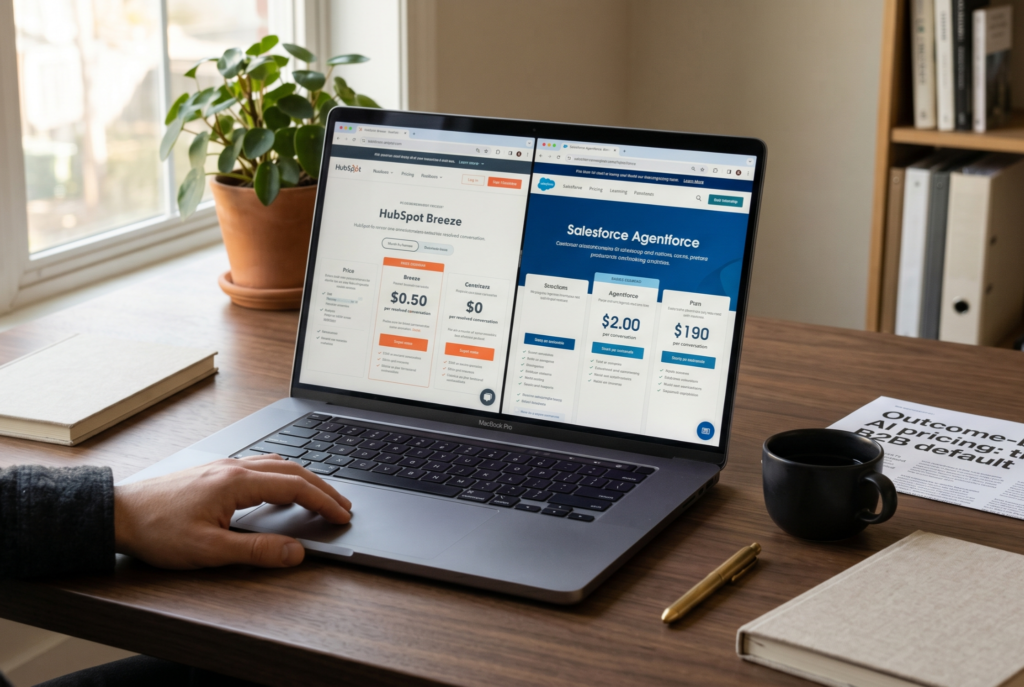
HubSpot moved its Breeze Customer Agent and Prospecting Agent to outcome pricing on April 14, 2026. The Customer Agent charges $0.50 per resolved conversation, where resolved means the agent fully addressed the support issue without human escalation. The Prospecting Agent charges $1.00 per qualified lead. Both include a 28-day free trial for Pro and Enterprise customers, as covered by CX Today.
However, Salesforce took a hybrid approach. Agentforce still charges $2.00 per conversation as a consumption model, while also offering Flex Credits at $0.10 per action, with packages sold at $500 for 100,000 credits. Salesforce reported Agentforce ARR climbing from roughly $200 million in Q1 to $800 million by Q4 fiscal 2026, supported by 18,500 customers processing more than three billion workflows per month. Nvidia further reinforced the shift by launching an enterprise AI agent platform with Adobe, Salesforce, and SAP among 17 adopters, as reported by VentureBeat.
Therefore, both vendors recognised the same pressure. Procurement teams stopped accepting per-seat AI tiers when the underlying work is automation. The legacy SaaS pricing model that survived 25 years began collapsing inside 18 months of agent launches.
The three numbers procurement now benchmarks
Procurement teams evaluating a new AI vendor in 2026 now anchor on three numbers. The first is $0.50 per resolved conversation, set by HubSpot. The second is $2.00 per conversation, set by Salesforce. The third is $0.10 per action, set by Salesforce Flex Credits.
For example, a B2B SaaS startup shipping an AI support feature priced at $25 per user per month will be asked to justify the price against a $0.50 per resolution benchmark. If the average user resolves fewer than 50 tickets per month with the AI, the seat tier loses on simple math.
Consequently, the burden of proof on legacy pricing shifts to the vendor. The default question in 2026 procurement calls is no longer “how much per seat” but “how much per outcome.” Vendors who cannot answer in those terms lose the deal cycle.
How to redesign your AI tier in five steps
B2B product and revenue teams can move to outcome-based AI pricing using a five-step sequence.
Step one. Define the outcome unit. Pick a single, measurable event the buyer cares about: a resolved ticket, a qualified lead, a closed loop in a workflow. Vague outcomes like “engagement” will not survive a procurement review.
Furthermore, step two. Audit instrumentation. Confirm that the platform can detect, log, and attribute each outcome at event level. Without clean event data, outcome pricing turns into a billing dispute.
Step three. Set the unit price against the three public benchmarks. Anchor at or below $2.00 per conversation if the use case overlaps Salesforce. Anchor at or below $0.50 per resolution if the use case overlaps HubSpot. Stay above your marginal compute cost with margin.
Step four. Match trial length to enterprise eval cycles. HubSpot now offers 28 days on Breeze. A 14-day trial signals legacy SaaS thinking. Enterprise buyers will simply wait shorter trials out.
Step five. Rebuild the sales motion around the outcome metric. Account executives need to walk a buyer through expected monthly outcomes and the projected bill, not the seat math. Demo flows, proposals, and order forms all change.
The instrumentation gap that kills outcome pricing
The single biggest failure mode for B2B teams adopting outcome-based AI pricing is shipping the pricing page before shipping the measurement.
Consequently, every outcome on the pricing page needs an underlying event in production telemetry. A resolved conversation needs a clean signal that confirms the agent closed the loop without escalation. A qualified lead needs an event that confirms the lead met the agreed definition. Without those signals, buyers will dispute the bill and churn the contract.
Product teams that approach outcome pricing as a marketing change will fail the first billing cycle. Teams that approach it as an instrumentation, product, and pricing change together will scale.
Outcome-based AI pricing is the new floor, not the ceiling. The vendors who set the benchmarks in 2026, HubSpot and Salesforce, will keep tightening the unit price and pushing more of the work down the agent stack. B2B product teams have a one-quarter window to either match the benchmark or differentiate above it with a measurable, defensible outcome the buyer cannot get elsewhere.
Lumeneze works with B2B founders on the moment product, pricing, and the sales motion need to move together. Book a working session at calendly.com/ashikurrahaman/lumeneze.