
Table of Contents
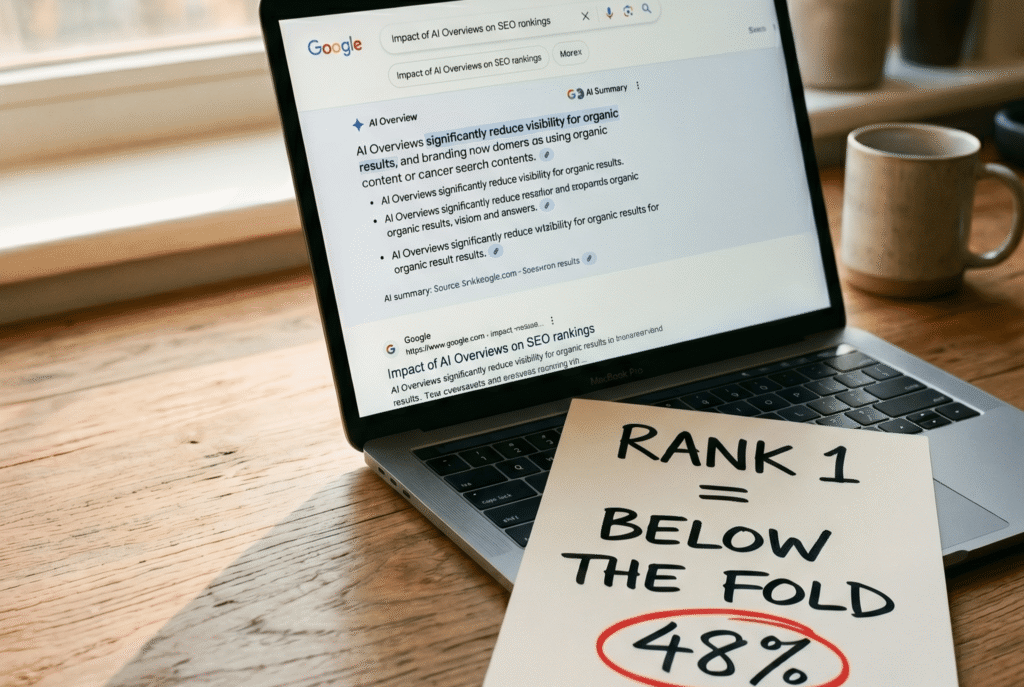
Search rankings stopped paying the bills. Google’s AI Overviews now appear on 48% of all queries and reach 2 billion monthly users (Wordstream, 2026). For most B2B founders, the AI overviews SEO strategy that worked in 2024 is now actively underperforming. Organic CTR is sliding 34 to 61% on uncited pages, while cited brands earn 35% more organic clicks and 91% more paid clicks.
The growth equation has flipped from “rank number one” to “get quoted by the model.” However, most teams are still measuring word counts and backlinks. As a result, they are paying to lose. This guide breaks down the new economics, the four layers of a working AI overviews SEO strategy, and what to deprioritize before the two-quarter compounding window closes.
Why AI Overviews changed SEO economics
The AI Overview is not a feature. It is a layout change. On desktop, it covers 42% of the visible screen. On mobile, 48%. The average AI Overview is now over 1,200 pixels tall, while a standard desktop viewport is approximately 900 pixels. In practice, the first organic result sits below the fold on most queries.
The query coverage tells the same story. Healthcare queries trigger AI Overviews 88% of the time. Education sits at 83%. Entertainment at 37%. Year over year, AI Overview frequency grew 58% across every tracked industry. For example, a B2B SaaS query that did not show an AI box twelve months ago likely shows one today.
In addition, AI Overviews reach 2 billion monthly users globally. The audience is no longer an early-adopter cohort. It is the entire search audience. Therefore, the organic search experience your buyer sees is the AI summary, not your blog.
AI Overviews SEO Strategy: from rank to citation
The economic flip is the part most teams have not absorbed. In contrast to the old playbook, where rank position predicted clicks, citation now predicts clicks. Brands cited inside an AI Overview earn 35% more organic clicks and 91% more paid clicks. Brands not cited lose 34 to 61% of their CTR (Position Digital, 2026).
In short, the rules of the AI overviews SEO strategy are simple: get cited or stay invisible. Furthermore, citation compounds. Once the model has used your content as a source for a category query, it tends to repeat. Your brand becomes the default answer for that question.
Consequently, the right unit of measurement is no longer keyword rankings. It is citation share. How often does the AI Overview name you when someone asks a question your buyer would ask? That is the new growth metric.
The four-layer citation framework
A working AI overviews SEO strategy operates on four layers, not one. Most teams fix one layer (usually the content layer) and wonder why citations do not arrive.
Layer one. Citation-ready content. Move from 3,000-word pillar pages to tight, structured, definitive answers. Each page should answer a buyer question in clean chunks the model can quote. Bullet points, comparison tables, definitive statements, and named statistics all increase pickup rate.
Layer two. Distributed authority. AI Overviews pull from Reddit threads, comparison sites, podcast transcripts, news mentions, and niche communities at the same time. Therefore, owning your domain is not enough. Your brand needs to appear across the open web surfaces the model reads.
Layer three. Author-attributed expertise. The model favors content tied to a real person with verifiable expertise over faceless brand pages. As a result, every published page should list a named author with a public profile, not “Marketing Team.”
Layer four. Schema and structured data. Article schema, FAQ schema, How-To schema, and Author schema make your claims machine-readable. In addition, structured data is one of the highest-leverage technical investments for citation rate, yet most B2B sites underuse it.
How to measure citation rate
You cannot grow what you do not measure. However, most B2B teams have no answer to the question “How often is our brand cited inside an AI Overview for our top fifty buyer queries?” Your AI overviews SEO strategy is only as strong as the citation data behind it.
Three measurement steps to run this quarter:
- Build a list of fifty to one hundred queries your ICP runs at each stage of the buying journey. Run those queries weekly. Capture which brands the AI Overview cites. Score your citation share against the top three competitors.
- Tie citations to outcomes. Track whether AI Overview queries that cite you produce more direct traffic, branded search lift, and pipeline than queries where you are not cited.
- Audit gap queries. For every query where a competitor is cited and you are not, identify which content layer is missing. Is it content? Off-domain authority? Author? Schema? Then close the gap.
What to deprioritize this quarter
Founder-led growth teams have a finite operating budget. As a result, the AI overviews SEO strategy that wins is also the one that ruthlessly drops what no longer works.
Word count goals. The model does not care that your page is 3,000 words. It cares that the answer is structured, accurate, and easy to extract.
Generic pillar pages. Hub pages aimed at every keyword variant get crowded out by AI Overviews. Specific buyer-question pages outperform them on citation rate.
Anonymous content. Pages without a named author rank lower in the citation pool. Therefore, attribute every piece to a real expert with a verifiable trail.
The two-quarter compounding window
The brands that build a working AI overviews SEO strategy in the next two quarters will compound. Citation is sticky. Once the model treats you as the default source, the next query for the same category usually cites you again.
In contrast, brands that wait for “more data” will see traffic decline month over month while their content output stays flat. The cost of waiting is a slow, expensive bleed.
For founder-led B2B teams, the move this quarter is direct. Audit your top ten buyer-question pages this week. Identify which of the four layers is missing. Restructure for citation, not for keyword density. To see how growth architecture and AI-driven search visibility connect inside a single operating system, visit Lumeneze.
The compounding clock is already running. Every week the model sees a competitor cited and not you, the gap widens. Start measuring. Start restructuring. The window will not stay open.