
Table of Contents
An AI GTM strategy is no longer a competitive advantage reserved for well-funded scale-ups. In 2026, it is the baseline architecture that separates B2B teams growing their pipeline from those watching it stall. This guide breaks down what an AI GTM strategy actually involves, why manual go-to-market motions are losing ground, and how early-stage founders can build a system that executes without depending on human intervention at every step.
This week, Aurasell launched an AI-native operating system for GTM workflows. Sellers on the platform are running 56% more sales cycles with no increase in headcount. That number is not remarkable because of the product. It is remarkable because of what it confirms about the direction every serious B2B team is moving.
What an AI GTM Strategy Actually Means in 2026
For most founders, AI in go-to-market still means acceleration. A smarter email tool. A lead scoring model. A research assistant that speeds up what a human was already doing.
However, the teams growing fastest in 2026 are not using AI to go faster. They are using it to restructure the motion entirely. The distinction matters enormously.
An AI-assisted GTM still has a human at the center of every decision. The AI provides information. The human decides and acts. Every step in the funnel waits for a person to push it forward.
An AI-executed GTM removes that dependency. The system identifies signals, makes routing decisions, initiates outreach, monitors responses, and adjusts the approach. Human attention gets applied at the moments it creates the most value, not at every administrative handoff.
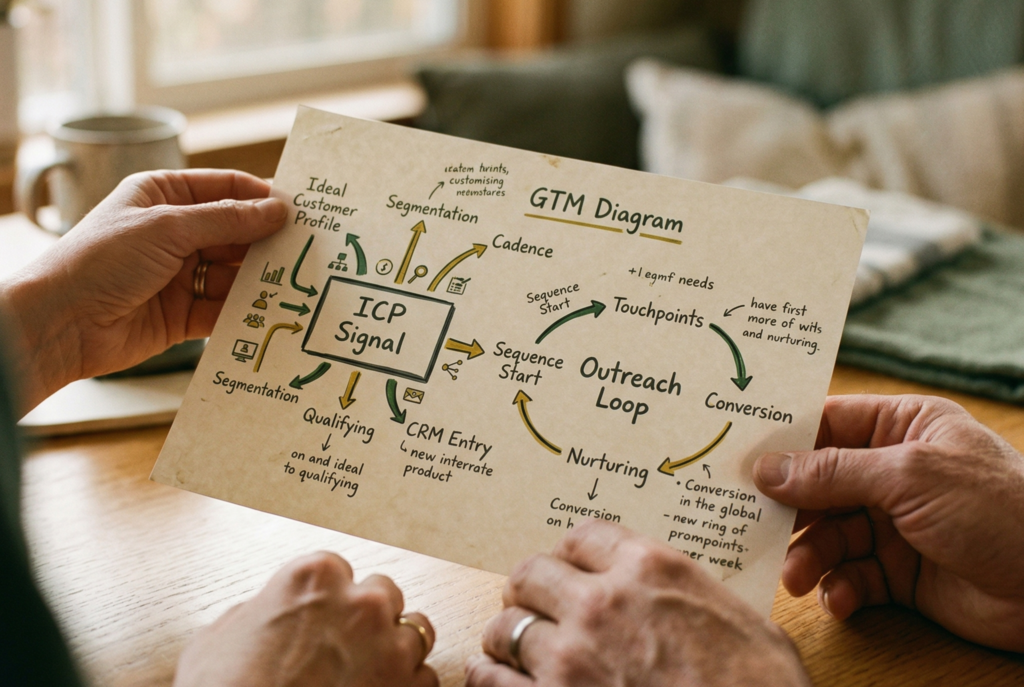
Therefore, a true AI GTM strategy is not a stack of tools. It is a system architecture. The ICP becomes a live data model rather than a static document. Outreach becomes a feedback loop rather than a sequence you set once. The pipeline becomes a model that directs human attention rather than a view someone logs into to update manually.
Why Manual GTM Motions Are Falling Behind
The data on this is direct. According to ZoomInfo’s 2026 GTM benchmark, sellers who partner with AI hit quota 3.7 times more often than those working without it. That is not a marginal gain. It is a structural gap.
Furthermore, B2B companies running AI-driven sales execution report 36% faster deal cycles than manual teams. HatHawk’s 2026 research on AI agent automation in B2B sales shows this gap widening across company sizes and segments.
In contrast, manual GTM motions carry a hidden cost that most founders underestimate. Every step that waits on a human creates latency. Leads go cold. Follow-up timing slips. Signals that should trigger action get missed because the person who was supposed to notice them had twelve other priorities.
For early-stage founders especially, this is critical. When the team is small, every human bottleneck in the GTM motion multiplies. One person going offline stops multiple steps in the pipeline simultaneously. The system does not run unless someone is pushing it.
As a result, the teams pulling ahead are not necessarily bigger or better funded. They have removed the human from the execution layer and applied human judgment to the design layer instead.
The Three-Layer GTM Framework That Works
At Lumeneze, the approach to building an AI GTM strategy for early-stage B2B founders follows three connected layers. Each layer builds on the one before it. Skipping a layer produces the tool-stacking problem most teams encounter.
Layer 1: The ICP as a live signal. The traditional ICP is a document. A set of firmographic criteria assembled once and referenced occasionally. An AI-native ICP is a data model that refreshes continuously. It tracks behavioral signals, intent data, and trigger events. It tells the system who is ready to engage right now, not just who fits a general profile.
Layer 2: Outreach as a feedback loop. Most outreach sequences are static. They fire at preset intervals regardless of how the prospect is responding. An AI-executed outreach loop reads response signals, adjusts timing, modifies messaging based on what is working, and routes warm leads to human attention at the right moment rather than on a calendar schedule.
Layer 3: Pipeline as an intelligent model. A CRM view shows you what happened. A pipeline model tells you what to do next. When AI sits at this layer, it surfaces which deals need attention, predicts where friction will appear, and helps human decision-makers focus on the highest-leverage actions rather than updating fields manually.
Consequently, the system as a whole runs between human touchpoints, not because of them. Human judgment shapes the architecture. AI runs the execution.
Three Practical Shifts for Early-Stage B2B Founders
Building a functioning AI GTM strategy does not require a large team or a large budget. For early-stage founders, the practical work starts with three specific shifts.
Shift 1: Stop treating your ICP as a static document. Rebuild it as a set of live criteria the system can act on. Define which data signals indicate readiness to engage. Connect those signals to your outreach trigger logic so the system acts when a signal fires, not when someone happens to check the spreadsheet.
Shift 2: Separate your outreach architecture from your outreach content. Most teams spend 80% of their time on message copy and 20% on the logic that determines who gets what message when. Invert that ratio. The architecture determines outcomes. The copy improves the margin.
Shift 3: Define what human attention is for. In an AI-executed GTM, human time is the scarce resource. It should go to relationship moments that require genuine judgment: late-stage calls, complex objections, strategic account decisions. Everything else should run on the system. If you have not defined that boundary explicitly, AI will fill in around the edges rather than replacing the core inefficiency.
For example, a founder running a ten-person B2B SaaS company does not need a twenty-person sales team to execute at the level that used to require one. They need a well-designed AI GTM system and two or three people who understand how to work within it.
The Right Next Step
The gap between AI-native GTM teams and manual teams is not closing on its own. Every quarter a manual motion runs, the compounding advantage of the AI-executed version grows.
However, the place to start is not tool selection. It is motion design. Before evaluating any platform or automation layer, a founder needs a clear answer to one question: what does the GTM motion look like when no one is actively pushing it?
If the honest answer is “it stops,” then the work is architectural, not technological. The AI GTM strategy comes after the architecture. The tools come after the strategy.
Lumeneze works with early-stage B2B founders to design that architecture and build the systems that run it. If you are building your GTM motion in 2026 and want it to scale without depending on headcount, the right starting point is a clear-eyed assessment of where human bottlenecks are hiding in your current process.