
Table of Contents
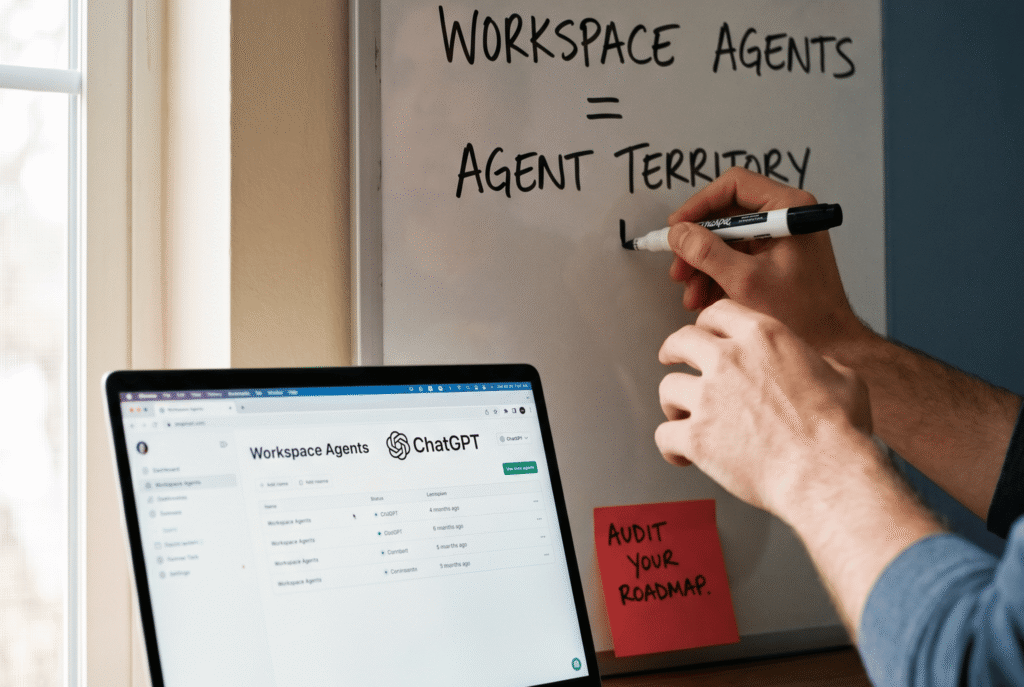
On April 22, 2026, OpenAI launched Workspace Agents inside ChatGPT. For B2B founders and product leaders, this is the moment AI product strategy for B2B stops being a roadmap line item and becomes a structural question. Persistent agents that connect to Slack, Salesforce, Notion, and Google Drive now run inside the tools your customers already pay for. The workflows your product was built to coordinate are now competing with infrastructure your users did not have to buy.
This post breaks down what Workspace Agents actually do, why they change the product strategy equation for B2B teams, and the three questions every product leader needs to answer before the next sprint planning session.
What OpenAI Workspace Agents Actually Are
Workspace Agents are persistent, schedule-driven AI agents that live inside ChatGPT for Business, Enterprise, and Edu plans. Unlike earlier custom GPTs, these agents run in the cloud, persist across sessions, operate on triggers or time-based schedules, and connect directly to Slack, Google Drive, Microsoft applications, Salesforce, and Notion.
According to VentureBeat, OpenAI designed Workspace Agents as a direct successor to custom GPTs, built to plug into enterprise tooling and run complex, multi-step workflows without human intervention. Teams can deploy agents inside Slack to pick up requests as they arrive, or schedule them to run when the team is offline.
In practice, this means automated onboarding sequences, status reporting, cross-tool data syncing, meeting prep, handoff coordination, and customer follow-ups can now run as persistent agents inside tools your customers already use. Powered by GPT-5.5, which OpenAI released on April 24 with significantly stronger agentic and knowledge-work capabilities, the reliability ceiling for these workflows moved substantially higher in a single week.
Why Your AI Product Strategy for B2B Needs an Audit Now
For the past three years, B2B product teams treated AI as an enhancement layer. Add AI to search. Add AI to reporting. Add AI summaries to the inbox. The underlying product value stayed intact. AI made it faster.
However, Workspace Agents change the structure of the problem. The question is no longer “how do we add AI to our product?” It is “which parts of our product just became agent defaults?”
Deloitte’s 2026 technology predictions report notes that AI agents are already shifting SaaS budgets, with enterprise customers consolidating tool spend toward platforms that include native agent capabilities. For independent SaaS products, particularly those in workflow coordination, project management, and productivity spaces, this represents a direct demand-side threat.
Consequently, roadmap items that felt safe six months ago, such as automated reporting, workflow handoffs, onboarding sequences, and status update tooling, are now in a contested zone. An agent can handle them. Your product still needs a reason to.
This is the core challenge for AI product strategy in B2B right now: the baseline of what software is expected to deliver has shifted, and roadmaps built on the old baseline are exposed.
The Three Questions That Define Your Defensible Surface
Every B2B product team needs to answer three questions before the next planning cycle. These questions are not rhetorical. They produce specific decisions.
Question 1: Which of your core workflows could a workspace agent handle within 30 days?
Be specific. List the five highest-used workflows in your product. For each one, ask: if a customer team set up a Workspace Agent connected to their Slack and CRM, could the agent handle this without your product? If the answer is yes for three or more, you have a roadmap problem that needs addressing now, not next quarter.
Question 2: Where does your product hold context an agent cannot access?
In addition, ask where your product creates or holds value that a general agent cannot replicate. This is usually proprietary data, domain-specific logic, relationship history between users, or embedded trust. The product that holds unique context survives agent displacement. The product that is a workflow wrapper does not.
Question 3: What decisions in your product require human judgment that AI will not make?
Furthermore, identify where your product facilitates a consequential human decision. Hiring decisions. Procurement approvals. Strategic prioritization. These moments require accountability and judgment that a persistent agent is not positioned to hold. Build toward those moments, not away from them.
How to Rebuild Your B2B Product Roadmap Around Agents
The right response to Workspace Agents is not to add agent features to your product. That becomes table stakes within 12 months. The right response is to position your product as the orchestration layer that determines what agents do.
For example, a B2B startup in the sales enablement space does not need to build a persistent agent. It needs to be the system that holds customer relationship data, deal history, segment logic, and decision rules that tell any agent what to prioritize. The agent becomes a capability. The product becomes the intelligence layer the agent runs on.
As a result, the architectural shift for product teams is this: move from output to context. The product that holds the richest, most domain-specific context for a given job will define what agents can and cannot do in that space. That is the defensible position in B2B AI product strategy for the next three years.
Practically, this means three roadmap shifts. First, accelerate anything that deepens proprietary data capture. Second, deprioritize workflow automation features that a general agent can now handle. Third, build the API and integration surface that makes your product the source of truth for agents operating in your domain.
What B2B Founders Should Do This Week
Run the three-question audit with your product team this week. Be honest about which parts of your roadmap are now in contested territory. Then identify the two or three areas where your product holds context, data, or domain logic that a general agent cannot replicate.
Furthermore, consider running a direct test. Set up a Workspace Agent connected to your own team’s Slack and Notion. See what it handles in 30 minutes. That test will tell you more about your roadmap exposure than a two-hour planning session.
At Lumeneze, we work with early-stage B2B founders running exactly this kind of product and GTM strategy audit. The companies that move through this shift cleanly are not the ones with the largest teams. They are the ones that ask the right questions early and rebuild their roadmap around defensible value before the market forces the conversation.
If you want to run a focused AI product strategy audit for your B2B startup, book a 15-minute call: calendly.com/ashikurrahaman/quick-intro.
Which part of your current B2B roadmap do you think is most exposed to agent replacement? Leave a comment below.