
Table of Contents
- Why Solo Consultant AI Workflows Are Replacing Back Offices
- The Before and After: What Changes With the Right System
- The 5-Workflow Solo Consultant Operating Framework
- The Cost and Performance Math
- How to Build Your Operating System This Quarter
- The Framework in Action: What Your Week Looks Like After
Solo consultant AI workflows are replacing entire back-office teams in 2026. The shift is not theoretical. It is happening across B2B consulting, GTM services, and growth operations right now. Solo-founded startups surged from 23.7% in 2019 to 36.3% by mid-2025. As of early 2026, 38% of seven-figure businesses are led by solopreneurs who replaced traditional hires with AI-powered systems. This guide breaks down the exact 5-workflow operating framework that makes this possible, with the tools, costs, and setup logic for each layer.
Why Solo Consultant AI Workflows Are Replacing Back Offices
The traditional consulting model required headcount for every operational function. Research needed a virtual assistant. Outreach needed a copywriter. Reporting needed a project manager. Invoicing needed a bookkeeper. The overhead defined the floor for project pricing and the ceiling for margin.
However, the infrastructure that made agencies necessary has fundamentally changed. According to PrometAI’s 2026 solopreneur research, high-performing solopreneurs using AI outpace their peers by 2.3x in revenue growth. Among those surveyed, 91% report significant reductions in administrative burden, and 64% say their business would not have grown without AI tools.
Furthermore, a 2026 Zapier survey found that 63% of solopreneurs now use at least three AI tools daily, with 44% citing significant revenue gains as a direct result. The operational advantages that agencies once held, including speed, breadth of skill, and production quality, are no longer exclusive to teams.
Therefore, the question is no longer whether solo consultant AI workflows can replace a back office. The question is how fast you can build the system.
The Before and After: What Changes With the Right System
The transformation is measurable across every dimension that matters to a solo consultant.
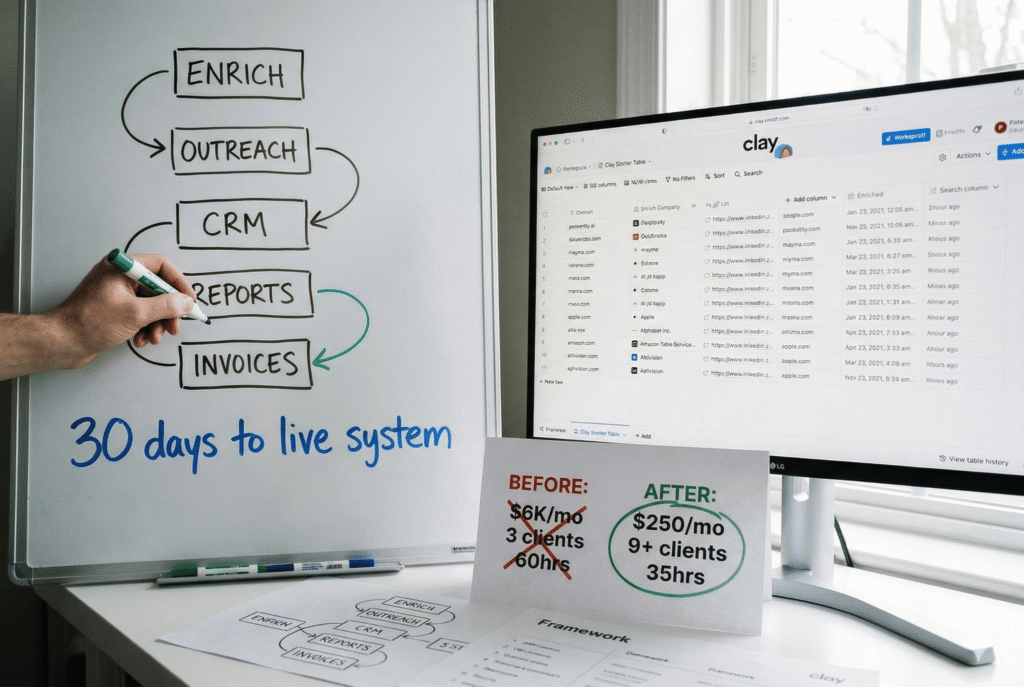
Before the operating system: A VA for lead research at $1,500 to $2,500 per month. A freelance copywriter for outreach at $1,000 to $2,000 per month. A bookkeeper for invoicing at $500 to $1,000 per month. A project manager or coordinator at $1,500 to $3,000 per month. Total overhead: $4,500 to $8,500 monthly. Maximum client capacity: three projects. Weekly hours: 50 to 60. Operating margin: 15% to 25%.
After the operating system: Five AI workflows running on Clay, Apollo, Claude, Make.com, and a lightweight CRM. Total tool cost: $200 to $1,000 per month. Client capacity: 8 to 12 projects. Weekly hours: 30 to 40. Operating margin: 60% to 80%.
As a result, the solo consultant who builds this system is not just saving money. They are buying back the hours that compound into higher-value strategic work, more client capacity, and faster business growth. At a $200 per hour billing rate, saving just one hour per week pays for the entire premium tool stack in a single session.
The 5-Workflow Solo Consultant Operating Framework
Each workflow in this solo consultant AI workflows framework connects to the next. Data flows automatically between layers. The consultant reviews and decides. The system executes.
Workflow 1: Lead Research and Enrichment. Clay pulls firmographic data from multiple sources. Apollo enriches individual contacts with verified emails, phone numbers, and role data. An AI scoring agent evaluates each lead against the client’s ICP criteria and assigns a priority tier. What took a virtual assistant six hours now completes in twelve minutes. The enrichment is deeper because the system pulls from more data sources simultaneously than any single researcher can access.
Workflow 2: Personalized Outreach Generation. Instead of writing templates and swapping variables, AI generates fully personalized sequences directly from enrichment data. For example, each prospect receives a custom angle based on their company stage, recent funding activity, role responsibilities, and industry signals. The consultant reviews and approves in 30-minute batches rather than spending two days writing from scratch. Hours saved per week: 8 or more.
Workflow 3: CRM Pipeline Automation. Automated triggers move deals through stages based on reply signals, meeting bookings, and engagement patterns. In addition, follow-up sequences fire based on time-since-last-contact rules. No manual drag-and-drop. No forgotten leads. The pipeline stays current without daily maintenance, and the consultant gets a clean view of where every deal stands at any moment.
Workflow 4: Client Reporting. Weekly status reports pull data from live dashboards, summarize progress against KPIs, and deliver to the client’s inbox on schedule. Consequently, the consultant sets the format and data sources once. The system handles compilation, formatting, and delivery every week. No Monday morning scramble. No manual screenshots pasted into documents.
Workflow 5: Invoice and Proposal Management. Scope changes trigger updated proposals with accurate line-item breakdowns based on the consultant’s hourly rate and project structure. Invoices generate on schedule with automated follow-up sequences for overdue payments. Furthermore, the financial operations run on rails instead of manual tracking in spreadsheets.
The Cost and Performance Math
The financial case for solo consultant AI workflows is a category shift, not a marginal improvement.
A complete AI workflow stack costs between $3,000 and $12,000 per year. In contrast, a single virtual assistant costs $2,000 to $5,000 per month. That represents a 90% to 98% reduction in operating costs for equivalent functional coverage.
In addition, 29.8 million solopreneurs operate independently in the United States, accounting for 82% of all small businesses. These one-person operations contributed $1.7 trillion to economic activity in 2025, representing 6.8% of total U.S. GDP. The scale of the shift is not a niche trend. It is an economic restructuring.
For example, most solo consultants who track their time report the full AI stack paying for itself within the first two weeks of adoption. At a $200 per hour billing rate, saving 10 to 15 hours per week translates to $2,000 to $3,000 in recovered capacity every week. That recovered time goes directly into client work, business development, or strategic projects that grow revenue.
Therefore, the ROI calculation is not even close. The question is not whether the investment pays off. It is how much capacity you leave on the table every week you delay building the system.
How to Build Your Solo Consultant AI Workflows This Quarter
Building the full operating system does not require a six-month project. Here is the implementation sequence that works.
Week 1: Start with lead enrichment. Set up Clay and Apollo. Define your ICP scoring criteria. Run your first batch of 50 leads through the enrichment workflow. Compare the output quality and speed against your current manual process. This is the quickest win and builds confidence in the system.
Week 2: Add outreach generation. Connect your enrichment output to an AI drafting workflow. Generate personalized sequences for the leads you enriched in week one. Review, approve, and send your first AI-generated batch. Measure time saved against your previous outreach writing process.
Week 3: Automate CRM updates. Set up triggers in Make.com or Zapier that move deals through pipeline stages based on reply signals and meeting bookings. As a result, your pipeline stays current without daily manual updates.
Week 4: Build reporting and invoicing. Create automated report templates that pull from your CRM and project dashboards. Set up invoice triggers based on project milestones or schedule. Consequently, the full operating system is live within 30 days.
The design principle behind each workflow is the same. Every step triggers automatically based on a specific event, not a manual prompt. Human review happens at decision points, not execution points. Data flows between tools without manual export and import.
The Framework in Action: What Your Week Looks Like After
Monday morning: client reports have already landed in inboxes. Your CRM shows updated pipeline stages from the weekend’s engagement data. A batch of 40 enriched leads is ready for review.
In addition, you spend 30 minutes reviewing and approving outreach sequences. Another 20 minutes scanning the pipeline for deals that need your direct attention. The rest of the day is client work.
By Friday, invoices have gone out on schedule. Follow-ups for overdue payments are running. Your lead pipeline is full for next week’s outreach batch. You did not format a single report, drag a single deal card, or write a single outreach email from scratch.
This is what solo consultant AI workflows look like when the system runs the operations and you run the strategy.
At Lumeneze, the approach to building these systems starts with mapping the exact operational bottlenecks in your current practice, then designing the 5-workflow framework around your specific tools, clients, and billing structure. The goal is a live operating system within 30 days.
The firms still pricing based on headcount are competing against solo operators whose costs dropped by 90% and whose speed increased by 10x. That gap widens every quarter. The time to build the system is now.
Book a 15-minute call to see how this framework applies to your practice: calendly.com/ashikurrahaman/quick-intro