

Table of Contents
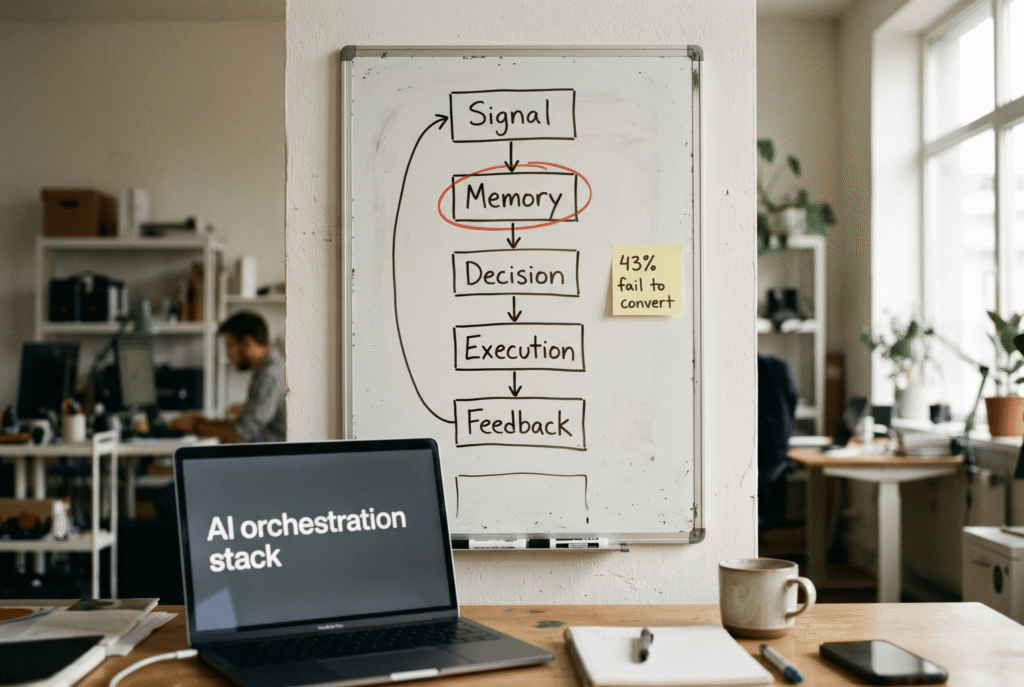
The AI orchestration stack is what separates a B2B team that runs connected revenue systems from one that runs a pile of disconnected tools. Demand Gen Report research in 2026 found that 43% of B2B marketers say their campaigns look successful but do not translate into actual revenue. The cause is almost always the same. Multiple AI tools run in parallel, none share context, and the pipeline leaks between them.
However, the fix is not another tool. The fix is orchestration. A true AI orchestration stack has five layers that pass state from one to the next. This guide walks through each layer, a before and after case study, the correct build order, and a 5-step starting plan your team can apply this quarter.
Why green dashboards hide broken pipelines
Most B2B teams added AI at every funnel layer during 2025. Intent data, lead scoring, email automation, enrichment, and ad targeting each got an AI upgrade. Each tool now reports positive results on its own dashboard.
However, the individual wins do not add up. Open rates rise. Lead scores climb. Pipeline stages move. Revenue stays flat.
Demand Gen Report’s 2026 B2B research found that 43% of marketers live in exactly that gap. Their green dashboards hide a structural problem. Each tool operates on its own snapshot of the customer, and none of them share what they learn.
For example, an enrichment tool might flag a fresh VP of Marketing hire at a target account. If that signal never reaches the email sequencer, the sequence keeps running the old intro as if nothing changed. The enrichment tool logs a win. The sequencer logs a win. Revenue logs nothing.
As a result, teams keep buying tools to fix a problem no tool can fix. The problem is not intelligence. It is connectivity.
The 5-layer AI orchestration stack explained
A real AI orchestration stack has five layers. Each one does a specific job, and each one reads from and writes to the layers next to it. Removing any single layer breaks the whole system.
Layer 1. Signal. The signal layer collects and normalizes every source of data that tells the system something new about an account. Intent feeds, product usage, ad engagement, buying committee moves, support tickets, and firmographic updates all flow in. The signal layer turns raw events into a clean, structured feed.
In addition, the signal layer filters noise. Not every event is a buying signal. Without filtering, downstream layers drown in low-value data.
Layer 2. Memory. The memory layer is a unified context store where every agent reads and writes. One account object holds the current state of the relationship. Every new signal, action, or outcome updates that object.
Therefore, an execution agent that drafts a follow-up email reads from the same memory as the scoring agent that set the priority. No duplicate state. No conflicting views of the account. A Gartner forecast projects that 40% of enterprise applications will embed AI agents by end of 2026, up from less than 5% in 2025. Most of those embeds will still fail to share memory, which is exactly why they will underperform.
Layer 3. Decision. The decision layer turns memory state into a next action. Scoring, prioritization, routing, and sequencing logic all live here. Given what the system now knows about an account, what should happen next?
For example, a decision layer might say: this account just triggered three high-intent signals and has a new VP of Growth, route it to Rep A, start sequence B, queue a direct mail gift for next week. Without this layer, execution agents run on hard-coded rules. With it, execution adapts to every new signal in real time.
Layer 4. Execution. The execution layer is where agents take action. Outbound emails, LinkedIn requests, enrichment pulls, qualification calls, booking flows, and CRM updates all run here. Each agent reads from memory, executes its task, and writes the outcome back to memory.
Furthermore, multiple execution agents can run in parallel without stepping on each other, because they all share the same memory state. The memory layer prevents duplicate outreach and conflicting actions.
Layer 5. Feedback. The feedback layer closes the loop. Every outcome, whether a reply, a booked call, a lost deal, or a no-show, flows back into the signal and decision layers. The system learns which signals actually predict revenue and adjusts scoring, sequencing, and routing accordingly.
Consequently, orchestrated stacks get smarter every week. Disconnected stacks do not, because the system never sees the full outcome of its own actions.
Before and after: a B2B SaaS case study
Consider a 12-person B2B SaaS selling a product analytics platform. Their before state looks familiar to most readers.
Before. Five tools run in parallel. An intent vendor flags hot accounts. A scoring tool ranks leads inside the CRM. An email tool runs sequences. A LinkedIn tool runs connection campaigns. An enrichment tool refreshes records weekly.
Each tool reports positive metrics. However, the SDR team complains that leads are cold. Marketing reports 240 MQLs per month. Sales closes 6 deals. The team is convinced the intent data must be low quality.
In contrast, after building the orchestration stack, the same team reaches a different state.
After. Signal is normalized in one feed that combines intent, product usage, and funding events. Memory is a single account object updated in real time. Decision scores every account nightly and queues a next action. Execution runs the email, LinkedIn, and enrichment agents from the same memory. Feedback loops reply rates and closed deals back to the decision layer.
As a result, MQL volume drops by 20%, but closed deals per month rise from 6 to 14. The reason is simple. The system stopped emailing accounts that were not ready and started prioritizing accounts that were.
Furthermore, the SDR team spends less time researching accounts. The memory layer already holds the context. They spend more time on the high-priority conversations the decision layer queues up.
This pattern shows up repeatedly at Lumeneze. More detail on how the Lumeneze team applies the AI orchestration stack to B2B SaaS growth is available on the services page.
The build order: where most teams go wrong with the AI orchestration stack
Most teams build in the wrong order. They start with execution. More sequences, more outreach, more tools.
However, execution without memory is noise. Memory without signal is a static database. Signal without decision is a dashboard. Decision without feedback is a guess that never gets corrected.
The correct build order runs in this sequence.
First, build memory. A unified account object that all agents will read and write against. This is the hardest layer because it usually requires rethinking the CRM schema.
Second, build signal. Start with 2 to 3 high-quality intent sources, not 10. Normalize them into memory.
Third, build decision. One scoring model, one routing rule, one sequencing logic. Keep it simple until it works.
Fourth, build execution. Start with one or two agents that read from memory. Do not add a third until the first two produce measurable outcomes.
Finally, build feedback. Pipe reply rates, close rates, and deal outcomes back into decision and signal. Let the system start learning from itself.
Therefore, teams that build in this order skip the trap that shows up across enterprise adoption data. ConvertMate’s 2026 State of AI Orchestration in Marketing research shows 88% of organizations adopted AI orchestration in some form, but only 28% reached mature capabilities. Mature orchestrators are 3x more likely to have a unified data layer and see 2 to 3x better ROI across revenue, customer insight, and cost efficiency. Build order is the single largest factor that puts teams into the 28% instead of the 72%.
Your 5-step starting plan
Here is a 5-step starting plan for any B2B team running a disconnected AI stack today.
- Audit the current stack. List every AI tool, what data it reads, and what data it writes. Most teams discover they have 4 to 8 tools and 0 shared state.
- Pick the account object. Decide where the unified account object lives. CRM, warehouse, or a dedicated memory layer. This becomes the single source of truth.
- Normalize 2 signal sources. Pick the two signal sources that most reliably predict revenue. Pipe them into the account object.
- Write one decision rule. Define one clear rule: if the account state looks like X, the next action is Y. Start small.
- Measure feedback. Track reply rates, booked calls, and closed deals against the decision rule. Adjust the rule monthly.
In addition, keep the tool list stable for the first 90 days. Changing tools before the orchestration is stable resets the learning clock.
Consequently, most teams can see measurable lift in one quarter by doing less, not more. Fewer tools, better connected, with one shared memory layer behind them.
Ready to build your AI orchestration stack? The Lumeneze team uses a 5-Layer AI Orchestration Worksheet with every B2B founder in the product and growth program. To get the worksheet, comment STACK on the LinkedIn post that pointed here or send a note through the Lumeneze contact form. A 15-minute strategy call can also be booked directly at calendly.com/ashikurrahaman/quick-intro.
Furthermore, the teams building the AI orchestration stack this quarter will run circles around teams still shopping for tools by Q4. The compounding starts the moment memory and feedback are connected.