

Table of Contents
AI agent product strategy is now the single clearest line that separates B2B software companies compounding through 2026 from companies defending margins all year. Buyers stopped rewarding features that autocomplete inside a sidebar. They started paying for agents that finish a workflow and report a measurable outcome. The shift is structural, not cosmetic, and the founders who see it first will own their category.
This guide lays out why the AI feature era is ending, what the agent-first playbook looks like, and three practitioner tests that tell a founder in under ten minutes whether their current product is sitting on the winning side of that line.
Why AI Feature Strategy Is Already Obsolete
For the last two years, adding a generative panel to an existing product was enough to win a premium tier and a bump in pricing. In 2026 that playbook is visibly failing. Buyers now dismiss AI sidebars the same way they once dismissed chatbots that could not answer a real question.
In contrast, the agent-first products are compounding in public. Intercom’s AI support agent Fin is on track to hit $100M in annual recurring revenue in early 2026. Fin is not a feature tucked inside a dashboard. Fin is the product. Customers pay per resolution, not per seat.
For example, Cursor crossed $300M ARR in late 2025. Its pricing ties revenue to code the agent ships and pull requests it helps merge. Output is the contract. The agent is the seller.
As a result, the AI feature category is losing ground to a different kind of software. In this newer category, the agent owns an entire workflow and the customer sees the outcome on a dashboard. The founder conversation is no longer “what can your AI do” but “what outcome does your AI produce, and how is it measured.”
The AI Agent Product Strategy Shift in 2026
The shift begins with one product decision. Does the AI assist a human, or does the AI own the workflow? Everything downstream flows from that single call.
Furthermore, Gartner projects 40% of enterprise applications will embed task-specific AI agents by the end of 2026, up from less than 5% in 2025. That is an 8x jump in roughly twelve months. The displacement is real, not speculative, and it is already priced into how enterprise buyers evaluate software.
However, most product roadmaps still treat AI as a feature layer. They add a panel, a button, a generative field. The buyer cannot tell the difference between that product and ten others priced the same. The value case collapses into a capabilities checklist, which is the worst position to defend during contract season.
AI agent product strategy reframes the question. The AI is not a layer. It is the delivery mechanism for an outcome the customer already wanted to buy. The human is the approver, not the operator. The workflow is owned by the product, not assembled by the user.
AI Agent Product Strategy: The Three Founder Tests
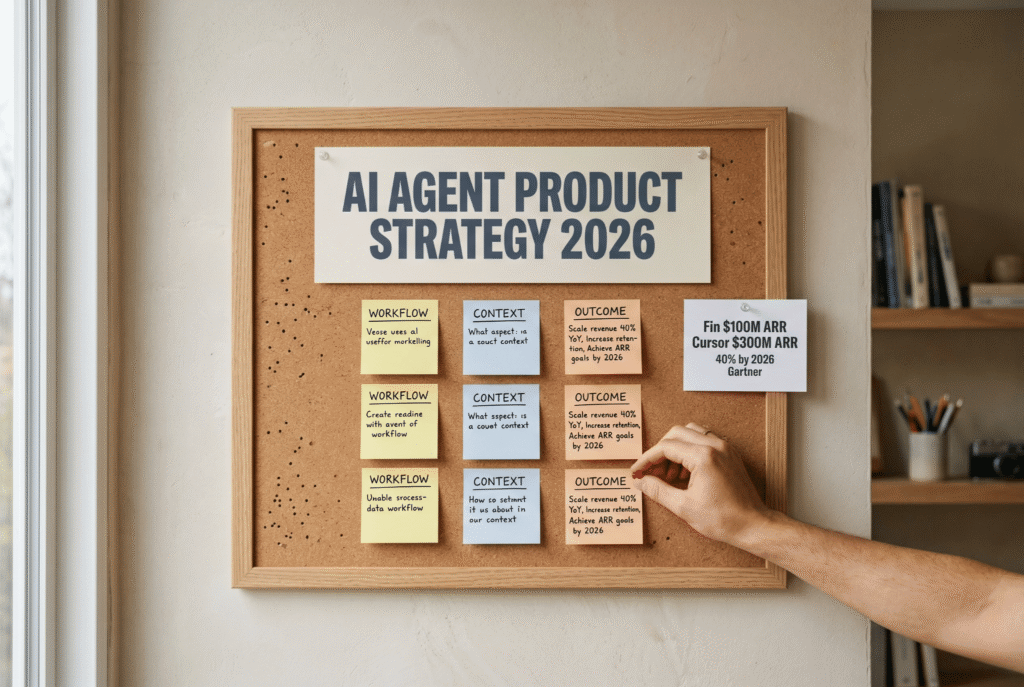
Three tests separate a real agent product from a feature dressed as one. Any founder can run their product through these in under ten minutes and get a clear read on the gap.
Test 1. Workflow completion. Does the agent finish the workflow end to end without constant hand-holding from the user? A feature starts a workflow and hands it back. An agent closes the loop and delivers the result. If your user still has to assemble the output from partial pieces, you are shipping a feature.
Test 2. Context access. Does the agent read context across the user’s systems, not just the prompt the user typed? A feature reacts to one input. An agent pulls context from the CRM, the inbox, the doc, the product, and the ticket queue before acting. If the only context your AI sees is the text box in front of it, you are not building an agent.
Test 3. Outcome reporting. Does the agent report a measurable outcome in the language of the buyer? Tickets resolved. Code shipped. Leads qualified. Meetings booked. A feature produces output. An agent produces outcomes and attaches the proof, so the customer never has to wonder what the AI actually did this month.
Therefore, the scoring is simple. Zero yes answers means you have a feature. One yes means a prototype. Three yes means you have a product that will still exist in twelve months. Anything in between is a roadmap conversation, not a launch.
How AI Agent Product Strategy Changes Pricing and Positioning
Once the agent owns a workflow, seat-based pricing stops making sense. The customer is not buying access. They are buying outcomes. Fin charges per resolution. Cursor charges by the unit of code shipped. Both companies walked away from the default seat model, and their revenue curves show why the market rewards the move.
In addition, positioning shifts on the landing page. Strip the AI label from the hero section. If the value proposition collapses, the product is a feature dressed as a product. If the value holds, the AI is simply the delivery mechanism for an outcome the customer already wanted. This landing page test takes two minutes and exposes the actual position of the product better than any analyst quadrant.
Consequently, the GTM motion changes too. Case studies stop being about features and start being about outcomes. Sales stops leading with capability and starts leading with results. The buying committee stops asking “what can it do” and starts asking “what has it produced.” Renewals stop being about usage and start being about value delivered.
For example, the product teams that treat AI agent product strategy as a first-class design choice compound on every renewal cycle. The teams that treat AI as a side feature spend 2026 explaining why their product is still worth the seat price. Those conversations rarely end with an expansion.
The Next Step for Founders
The timing window matters. By end of 2026 the agent-first products will own the default position in every category they touch. The feature-first products will still exist, but priced down and positioned as utilities rather than systems of record.
Furthermore, agent architecture is not only an engineering choice. It is a product strategy call that touches pricing, positioning, sales, and retention. Getting it right is less about AI models and more about deciding which workflow the agent owns and how the outcome gets measured in front of the customer.
For founders already shipping an AI feature, the question is whether the workflow behind it can be redefined so the agent owns the outcome end to end. For founders planning the next version, the question is which single workflow is worth owning completely, because owning one workflow beats touching ten.
Lumeneze works with founders to design the AI agent product strategy that fits their category, pricing model, and audience. A 15-minute strategy call walks through the three founder tests against your current roadmap and surfaces which workflow is worth committing to this quarter.
The category is rewriting itself this quarter. The AI feature era is ending. The AI agent era is compounding. Which workflow does your product fully own today, and which outcome does it report on by default?