
Table of Contents
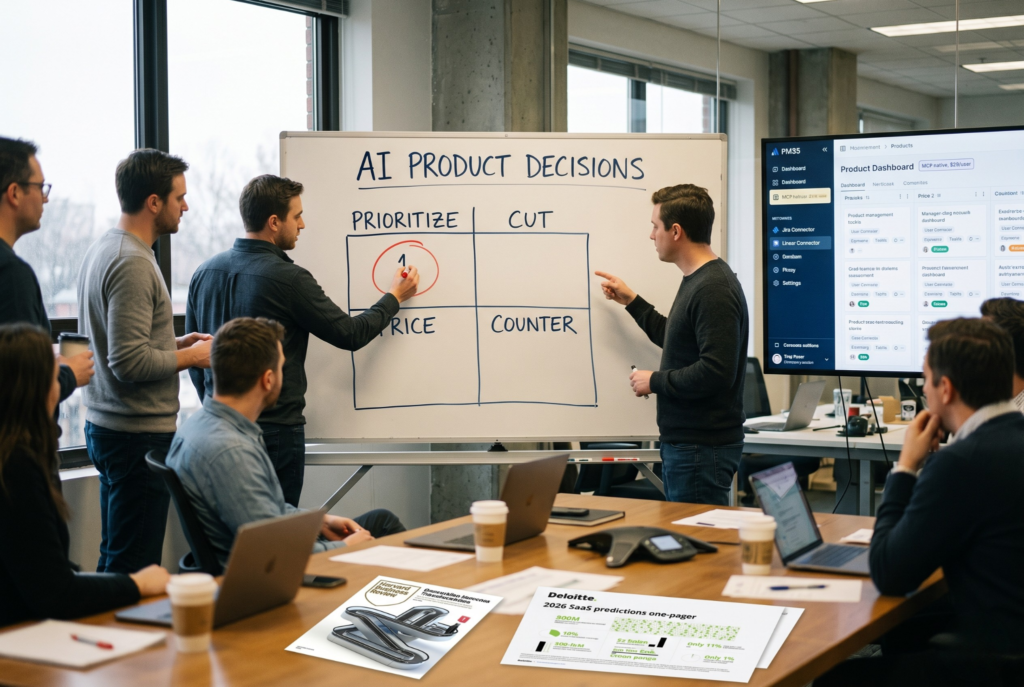
AI product decisions are the next frontier for B2B teams, and the first signals are already landing in 2026. Last week at SaaStock USA 2026 in Austin, a new platform called PM33 went public at 29 dollars per user per month, built on Model Context Protocol, connecting agents directly to Jira, Linear, Asana, GitHub, and Notion. The tool itself is the smaller story. The larger story is where AI is finally allowed to sit inside a product org.
For three years, AI handled the admin layer of product work. It drafted PRDs, summarized standups, and tidied up tickets. Useful, but bottom of the value stack. In 2026, AI is moving up the stack into decisions. Prioritization. Scope. Pricing. Competitive response. This piece lays out what the shift looks like, why it matters, and how to introduce it into your team without breaking the roadmap.
The Shift: From PM Admin to AI Product Decisions
For the last three years, product teams used AI to accelerate what was already slow: writing docs, summarizing calls, drafting release notes. That made individual PMs faster. It did not change where decisions got made or who made them.
However, the newer generation of tools reframes the question. They do not ask, “How do I ship faster?” They ask, “What should we ship next, and why?” That is a different layer of the product stack. The input is not a meeting transcript. The input is sprint capacity, strategic objectives, retention data, and competitive moves. The output is a recommendation, with trade-offs made visible.
As a result, the bottleneck is changing. It is no longer “can AI read my notes.” It is “does AI have enough structured context to be useful before the decision is made.” This is exactly what Model Context Protocol addresses, and it is why launches like PM33 matter beyond the feature list.
What PM33 Signals for AI Product Decisions in 2026
PM33 launched publicly on April 15 to 16, 2026, at SaaStock USA in Austin. The feature list reads like a standard PM suite: sprint planning, PRD generation, scenario modeling, competitive analysis. What is different is the wiring. Every agent inside PM33 reads structured product context through MCP rather than guessing from scattered prompts.
Furthermore, the broader market is moving in the same direction. Deloitte’s 2026 predictions for SaaS call out a shift from experimental AI pilots to budgeted AI agents inside core workflows this year. In February 2026, Harvard Business Review published a widely shared piece arguing that the main bottleneck in enterprise AI adoption is not model quality or infrastructure. It is product management judgment about where AI should actually contribute.
In other words, the platforms are ready. The models are ready. The gap is a clear product operating system for AI product decisions. Teams that build this muscle early will set the pace, because their AI gets better as context accumulates.
Four Decision Zones to Hand to AI First
Not every product decision should go to an AI agent first. Some require founder gut. Some require customer conversations that do not exist in any CRM. A good starting point is to target the four zones where evidence already lives inside your tools, but human attention is the bottleneck.
- Feature prioritization. Score each candidate against three signals: revenue impact, retention lift, and customer pull. AI pulls the signal and ranks. The PM reviews the top five.
- Scope cuts under capacity pressure. When a sprint goes over, AI proposes which items to drop based on dependencies, strategic weight, and effort, not on who shouted last.
- Pricing experiment selection. AI maps which segments and plans are worth testing first, using recent usage and churn data. It removes most of the paralysis around where to start.
- Competitive response calls. When a rival ships something, AI classifies it as ship, ignore, or counter, anchored to your positioning map and current roadmap, so the team does not chase every update.
In each case, the principle is the same. The AI compresses evidence. The human still makes the call. Over time, feedback on good and bad calls trains the agents, and the signal quality goes up.
Where Product Judgment Still Belongs to Humans
Before going all in, mark the places AI should not touch yet. Three decisions belong squarely with founders and product leaders.
First, the vision. The one or two sentence answer to “why do we exist, and what gets better in the world if we win.” AI can draft language. It cannot feel where the market is going before the data confirms it.
Second, the risk tolerance. Decisions about betting the company on a new wedge, or sun-setting a line of business, carry asymmetric consequences. Those stay with humans who own the outcome.
Third, the ethical calls. Dark patterns, forced upsells, data collection, and customer trust live here. Automated decisions work only when values are set by humans and enforced at every layer.
A 5-Step Plan to Start This Quarter
For founders and product leads who want to move before the end of Q2, here is a simple sequence. It does not require a platform purchase. It does require clean data and a willingness to let agents into the room.
- Pick one decision zone from the four above. Start with feature prioritization if unsure.
- Map the inputs. List every data source the decision already uses: CRM, product analytics, support tickets, revenue, churn.
- Give an agent structured access to those sources, either through MCP connectors or a shared data layer.
- Run the decision both ways for one sprint: human only, then human with AI-compressed evidence. Compare speed and quality.
- Codify the winning workflow. Move it into your product operating cadence. Expand to the next zone next quarter.
Consequently, AI product decisions stop being a slogan and start being a compounding advantage. The teams that operationalize this first will pay less per decision, make better calls, and free their best people for the work humans should still own.
If you want help designing the decision architecture for your team, Lumeneze builds AI-native product and GTM systems for early-to-growth B2B founders. Book a 15-minute call: calendly.com/ashikurrahaman/quick-intro.
Which of the four decision zones is the slowest in your product org right now? Drop the number in the comments and we will break down the most common fix.