
Table of Contents
Every ai workflows solo consultant stack in 2026 is replacing what used to require a full back-office team. For years, running a B2B consulting practice meant hiring researchers, copywriters, bookkeepers, and project managers before the first deliverable shipped. However, the infrastructure that made agencies necessary has fundamentally changed. Five AI-powered systems now handle 80% of the operational load that once demanded a team of four to six people. The consultants building these automated workflow systems are pulling ahead.
Why AI Workflows Matter for Solo Consultants Now
The shift toward solo consulting is not anecdotal. Solo-founded startups surged from 23.7% in 2019 to 36.3% by mid-2025, according to recent industry research. That acceleration tracks directly with the maturation of AI workflow tools that handle coordination-heavy tasks automatically.
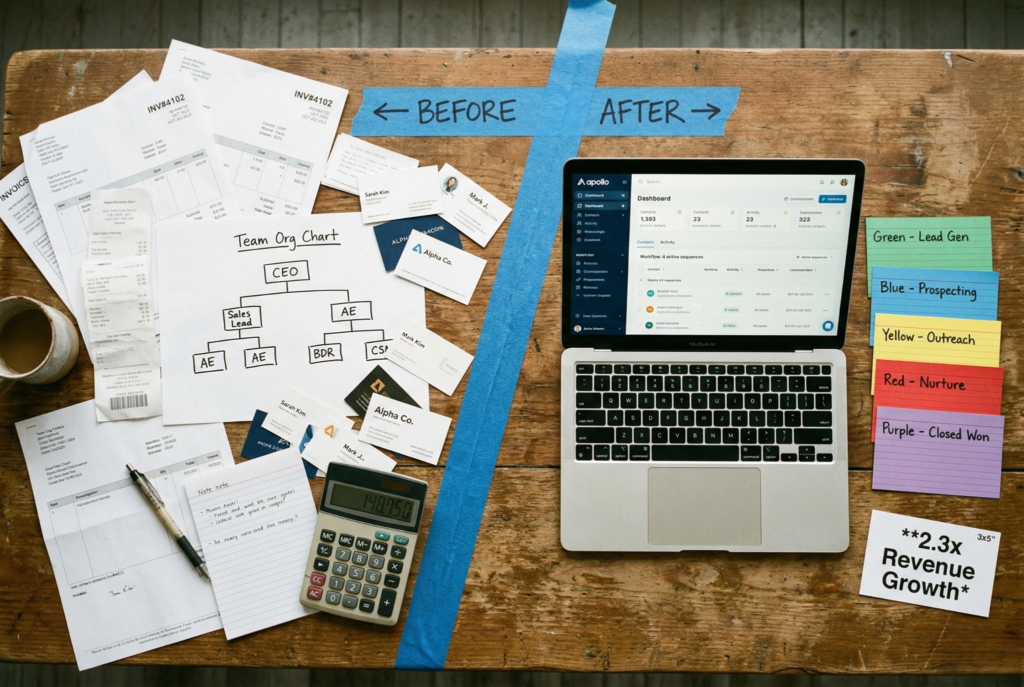
Furthermore, the performance data reinforces the trend. High-performing solopreneurs using AI outpace their peers by 2.3x in revenue growth. Among those surveyed, 91% report significant reductions in administrative burden, and 64% say their business would not have grown without AI tools.
In addition, the operational advantages that agencies once held are no longer exclusive to teams. Speed of output, breadth of capability, and production quality now belong to any practitioner willing to build the right systems. The ai workflows solo consultant model is becoming the default competitive unit for B2B services at the startup and growth stage.
Therefore, the question is no longer whether solo consulting is viable. It is whether your operational infrastructure matches the opportunity.
The Five AI Workflows That Replace a Back Office
For example, consider the five operational functions that consume the most time in a typical consulting practice: lead research, outreach, CRM management, client reporting, and invoicing. Each of these now has an AI-powered workflow that runs in minutes instead of hours.
The first workflow is lead research and enrichment. Tools like Clay pull company data from multiple sources, Apollo enriches individual contacts, and an AI agent scores each lead against the client’s ICP criteria. What used to take a virtual assistant six hours now completes in twelve minutes. The quality is higher because the enrichment pulls from more data sources simultaneously.
The second workflow is outreach drafting. Instead of writing templates and swapping variables, AI generates personalized sequences directly from enrichment data. Each prospect gets a custom angle based on their company stage, recent activity, and role. The consultant reviews and approves in batches rather than writing from scratch.
As a result, the third workflow, CRM pipeline management, becomes nearly autonomous. Automated triggers move deals through stages based on reply signals, meeting bookings, and engagement patterns. No manual drag-and-drop. No forgotten follow-ups. The pipeline stays current without daily maintenance.
Furthermore, the fourth workflow handles client reporting. Weekly status reports pull data from live dashboards, summarize progress against KPIs, and deliver to the client’s inbox on schedule. The consultant sets the format once. The system handles compilation, formatting, and delivery every week.
Consequently, the fifth workflow covers invoicing and proposal management. Scope changes trigger updated proposals with accurate line-item breakdowns. Invoices generate on schedule with automated follow-up sequences for overdue payments. The financial operations run on rails instead of manual tracking.
The Cost Comparison: AI Stack vs Traditional Overhead
The financial case for ai workflows in solo consultant practices is not marginal. It is a category shift in operating economics.
A complete AI workflow stack, including enrichment tools, AI drafting, CRM automation, reporting systems, and invoicing software, costs between $3,000 and $12,000 per year. In contrast, a single virtual assistant costs $2,000 to $5,000 per month, according to SelfEmployed’s 2026 analysis. That represents a 95% to 98% reduction in operating costs for the same functional coverage.
However, the cost savings are only part of the picture. The real advantage is speed. AI workflows execute in minutes. Human-dependent workflows execute in hours or days, with quality dependent on the individual and coordination overhead built into every handoff.
For example, a lead enrichment workflow that takes a VA six hours completes in twelve minutes with Clay and Apollo. An outreach sequence that takes a copywriter two days to personalize generates in thirty minutes with AI drafting from enrichment data. The compounding time savings across all five workflows recovers 8 to 12 hours per week.
Therefore, the solo consultant who builds these systems is not just saving money. They are buying back the hours that compound into higher-value strategic work, more client capacity, and faster business growth.
Building Your AI Workflows Solo Consultant Stack
The common tech stack for B2B solo consultants in 2026 follows a clear pattern. Make.com or Zapier handles workflow orchestration. Claude or ChatGPT powers language generation tasks. Clay or Apollo manages lead enrichment. A lightweight CRM like HubSpot or Monday.com tracks the pipeline.
In addition, the most effective stacks share three design principles. First, every workflow triggers automatically based on a specific event, not a manual prompt. Second, human review happens at decision points, not execution points. Third, data flows between tools without manual export and import steps.
For example, when a new lead enters the CRM, the enrichment workflow fires automatically. Enriched data feeds the outreach workflow. A reply triggers the CRM update workflow. A booked meeting triggers the reporting workflow to add the prospect. Each system feeds the next without the consultant copying data between tools.
As a result, the consultant’s role shifts from execution to oversight. The daily work becomes reviewing AI outputs, making strategic decisions, and engaging directly with prospects and clients. The operational machinery runs in the background.
What This Means for the Future of B2B Consulting
The structural shift from team-based to system-based consulting is accelerating. Agencies are not disappearing, but the threshold for competing with them has dropped dramatically. A solo consultant with a well-built AI stack can now deliver the same operational output as a small team at a fraction of the cost.
Consequently, the consultants who invest in building these ai workflows now will compound their advantage through 2026 and beyond. The market rewards operational leverage. The practitioners who own their systems rather than renting headcount are setting the new price floor for B2B services.
The firms still pricing based on team size are competing against solo operators whose costs dropped by 90% and whose speed increased by 10x. That gap will only widen as AI workflow tools improve.
The question for every B2B consultant in 2026 is straightforward: are you building systems, or are you still paying the coordination tax?