

Table of Contents
B2B GTM automation is not the problem. The sequence founders use to get there is.
In 2026, building automated outreach workflows, deploying AI agents for lead scoring, and running campaign orchestration at scale has become table stakes for competitive B2B teams. The tooling has never been more accessible. Clay, n8n, GoHighLevel, and a growing ecosystem of agentic AI systems can now run entire campaigns with minimal human input.
But effective B2B GTM automation requires more than good tools. It requires the right foundation underneath them. Without that, automation does not accelerate growth. It accelerates mistakes.
Why B2B GTM Automation Fails Early-Stage Founders
Most early-stage B2B founders automate too early. It is an understandable mistake. The tooling is available, the pressure to scale is real, and building automation infrastructure feels like building a growth engine.
What actually happens in most cases is this: founders build technically functional automation systems that are operationally broken. The outreach sequences run, but the messaging is unclear. The onboarding flows fire, but the activation logic is wrong. The lead scoring models qualify prospects based on the wrong signals.
Automation without a validated GTM foundation does not produce compounding growth. It produces compounding confusion. The volume goes up. The signal-to-noise ratio goes down. By the time the founder realizes the strategy is wrong, the automation has already delivered the wrong message to hundreds or thousands of potential customers.
According to research from Product Led, product-led growth is increasingly the standard for AI-native B2B companies in 2026, but the companies that execute it well are those who validated their activation logic manually before investing in automation infrastructure. The sequence matters more than the tooling.
The Four-Stage GTM Readiness Framework
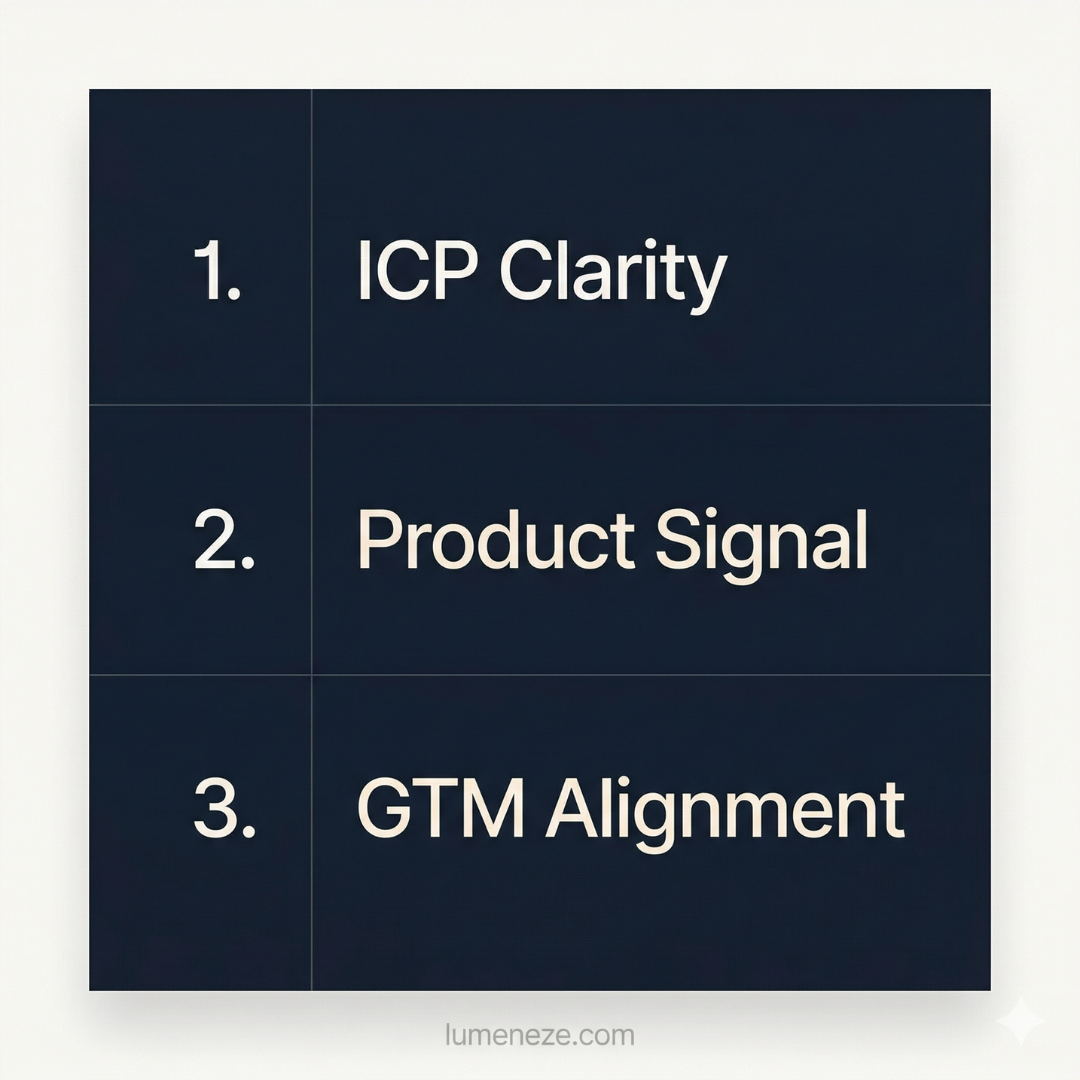
At Lumeneze, we use a four-stage framework to assess whether a company is ready to automate any part of their B2B GTM motion. Automation is only introduced at Stage 4. The three stages before it are not optional.
Stage 1: Positioning Clarity
Before any outreach tool is configured, the following must be true:
- You can name the exact type of company you serve, the specific role you sell to, and the precise problem you solve for them.
- You know why that person would switch from their current solution to yours, today, not in theory.
- Your value proposition is tested and proven to resonate, through actual conversations, not through internal belief.
Generic positioning produces generic results at scale. Until the positioning is sharp, any automation built on top of it will scale the wrong message.
Stage 2: Product Signal
Product signal means your product is demonstrably delivering value to a specific person in a specific situation. Not just signups. Not just trials. Genuine activation: a user experienced the core value of your product, understood it, and came back without being prompted.
This matters for B2B GTM automation because your automation stack will be built to drive users toward this moment. If you do not know what that moment is, or if it does not reliably happen for most users who reach it, no amount of automated nurturing will fix it. You need to identify the activation moment manually before you automate the path to it.
We also explore this framework in our work on product strategy for early-stage B2B companies.
Stage 3: GTM Architecture
GTM architecture is the deliberate design of your channels, messaging sequences, and conversion motions so they match how your actual buyers make decisions. Not how you assume they do. Not how you want them to.
This includes:
- Channel selection based on where your ICP actually spends attention and makes buying decisions
- Message sequencing that maps to the stages of your buyer’s decision process
- Conversion logic that moves prospects toward the activation moment you identified in Stage 2
Many founders build automation before completing this step. They end up with sophisticated automation infrastructure running on a poorly designed GTM motion. The result is high operational complexity with low output quality.
Stage 4: Automation
Now you build. Now you deploy the AI agents, the automated outreach sequences, the lead scoring models, and the workflow automation. Now it compounds. Because you are automating something that already works. You are not hoping automation will make a broken strategy work.
Effective B2B GTM automation at Stage 4 is genuinely powerful. It scales what is already producing signal. It removes manual work from processes that are already validated. It multiplies a working playbook.
What Automation Actually Looks Like When the Foundation Is Right
When the four stages are in sequence, B2B GTM automation produces different results than what most founders experience. Here is what changes:
- Outreach converts. Because the messaging is validated and the ICP is specific, automated sequences generate replies and booked calls rather than silence or spam flags.
- Activation rates improve. Because onboarding automation is built around a known activation moment, users reach it consistently rather than churning before they understand the product’s value.
- Feedback loops tighten. Automation generates data about what is working. When the foundation is solid, that data is interpretable and actionable. When it is not, the data is noise.
- The system compounds. Each improvement to the foundation makes the automation more effective. Each automation improvement generates better signal, which improves the foundation. This is what a genuine growth flywheel looks like.
Common Mistakes Founders Make With GTM Automation
These patterns appear repeatedly across early-stage B2B companies that invest in automation before completing the foundational stages:
- Automating outreach before validating ICP. The result is high volume outreach to the wrong segment. The automation makes it possible to contact thousands of people with a message that does not resonate with any of them specifically.
- Automating onboarding before identifying the activation moment. Users are moved through an automated flow that does not lead to genuine product value. Activation rates stay low regardless of how sophisticated the automation is.
- Building AI agent infrastructure before the GTM motion is proven. The agents are technically functional but operationally misaligned. They execute the wrong playbook at scale, and the company’s growth plateau is harder to diagnose because the infrastructure looks sophisticated.
- Measuring automation activity rather than business outcomes. Tracking emails sent, sequences triggered, and agents deployed rather than qualified conversations generated, activation rates improved, and revenue produced from automated motions.
The Real Compound Effect of Sequenced Growth
The compounding argument for B2B GTM automation is real, but it is often misapplied. The compound effect does not come from having more automation. It comes from having the right foundation, then applying automation to it.
A founder who spends three months getting positioning clarity, validating product signal, and designing GTM architecture before automating anything will produce better results in month six than a founder who began automating in month one without completing the foundational work.
This is counterintuitive in an environment where speed is fetishized. But it is consistently true in practice. The fastest path to a working automated growth system is to go slow at the beginning on the parts that matter most.
How Lumeneze Approaches This
At Lumeneze, we built our entire service model around this sequence. Every engagement starts with the foundation, not the tools. We do not recommend or implement automation infrastructure until Stages 1, 2, and 3 are solid.
This is different from how most agencies operate. The typical GTM agency wants to jump directly to implementation. Implementation is visible, billable, and easy to talk about. Positioning work and activation analysis are slower and harder to show as deliverables.
But the results are different. Companies that go through the full sequence before automating build growth systems that compound. Companies that skip the sequence build sophisticated infrastructure that requires constant manual intervention to produce mediocre results.
If you are an early-stage B2B founder and your current growth system is not producing compounding results, the problem is almost always upstream of your tooling. Start there.
If you want to work through the GTM Readiness Framework for your company, book a working session with the Lumeneze team.