
Table of Contents
The MCP automation standard is changing how AI agents connect to business tools. In April 2026, Microsoft shipped Model Context Protocol (MCP) as generally available in Copilot Studio, marking the moment this open protocol moved from experimental to enterprise-grade. For automation teams building AI workflows, this is the infrastructure shift that unlocks scale. At Lumeneze, we have been tracking this convergence closely because it changes how every B2B automation system should be architected from this point forward.
What Is MCP and Why It Matters for AI Automation
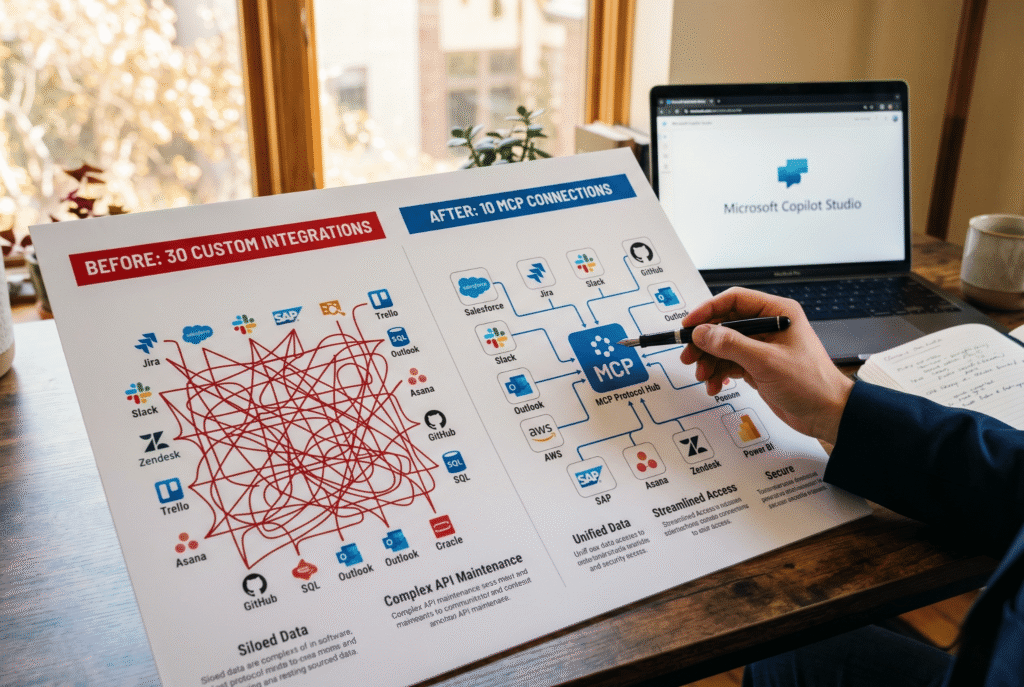
Model Context Protocol is an open standard that defines how AI agents communicate with external tools and data sources. Think of the MCP automation standard as a universal adapter. Before MCP, every AI agent needed its own custom integration for every tool it connected to. A Claude agent accessing Salesforce required completely different code than a Copilot agent doing the same task.
Furthermore, this created a multiplication problem. If you had 3 agent platforms and 10 tools, you needed 30 bespoke integrations. Each one had to be built, tested, and maintained separately. For example, updating one Salesforce API version meant touching every agent’s connector individually.
MCP collapses that equation. Build one connector per tool. Every MCP-compatible agent, whether it is Claude, Copilot, Cursor, or a custom agent, uses the same connection. The integration count drops from 30 to 10. Maintenance drops proportionally.
The MCP Automation Standard Goes Production-Ready
In April 2026, Microsoft shipped MCP as generally available in Copilot Studio. This is not a preview or a beta. It is production-ready, enterprise-grade support for the protocol across Microsoft’s entire agent platform.
However, Microsoft is not alone in this move. Workato launched eight production-ready MCP servers in February 2026 with enterprise-grade security, and announced plans for 100+ servers during the year. n8n added native MCP support to its automation platform, allowing agents to dynamically select which tools to trigger based on context.
As a result, the protocol layer for AI automation has converged faster than most teams expected. When the three largest categories of automation tooling (enterprise platform, integration middleware, and open-source workflow builder) all standardize on one protocol, the signal is clear.
Why 79% of Enterprises Are Stuck Without the MCP Automation Standard
According to Automation Atlas, only 21% of companies have successfully deployed AI workflows at enterprise scale in 2026. The remaining 79% are working through challenges around orchestration, governance, and connectivity.
In contrast to what many assume, the bottleneck is rarely the AI model itself. GPT-4, Claude, and Gemini are all capable of complex reasoning and task execution. The real friction sits in the layer between the agent and the tools it needs to use.
Therefore, every bespoke integration becomes a point of failure. API versions change. Authentication tokens expire. Data formats shift between platforms. Without a standard protocol, each connection is a liability that requires ongoing engineering time to maintain.
The MCP automation standard addresses this directly. By standardizing the communication layer, it reduces the surface area for failure and makes agent-to-tool connections maintainable at scale. This is why Microsoft, Workato, and n8n all converged on the same protocol independently.
How to Build MCP-First Automation Systems
For B2B teams building AI automation right now, the practical shift is straightforward. Stop investing in point-to-point integrations. Start building on MCP.
Consequently, the architecture looks different from traditional automation. Instead of building one integration per agent-tool pair, you build one MCP server per tool. That server exposes the tool’s capabilities through the MCP standard. Any agent that speaks MCP can then discover and use those capabilities without additional code.
For example, an MCP server for your CRM exposes actions like “create contact,” “update deal stage,” and “pull pipeline report.” Claude uses it. Copilot uses it. A custom Python agent uses it. Same server, same actions, zero duplication.
In addition, MCP servers can be shared across teams and even across organizations. Workato’s marketplace approach, with 100+ pre-built MCP servers planned for 2026, means many common tool connections will be available off the shelf. Teams only need to build custom MCP servers for proprietary internal systems.
What This Means for B2B Automation Teams in Q2 2026
The AI agent market is projected to grow from $7.84 billion in 2025 to $52.62 billion by 2030, a 46.3% compound annual growth rate. The companies that capture value from this growth will be the ones with clean, scalable infrastructure, not the ones with the most agents.
Furthermore, the window to build an MCP-first automation stack is open now. Microsoft going GA means enterprise buyers have a green light. Workato’s MCP marketplace means the ecosystem is real. n8n’s native support means open-source teams can adopt it without vendor lock-in.
The practical takeaway is this: audit your current agent integrations. Count how many bespoke connections you maintain. Then calculate how many you could collapse by moving to MCP. For most B2B automation teams, the reduction will be 50% or more. That is not just a cost saving. It is the difference between deploying new agents in weeks versus months.
The protocol war for AI agents ended quietly in April 2026. MCP won. The only question left is how fast your automation infrastructure catches up. If you want help auditing your current stack and building an MCP-first automation system, book a 15-minute call and we will map it out together.