

Table of Contents
AI product management is no longer a niche specialisation. By the end of 2026, Gartner projects that 40% of enterprise applications will incorporate task-specific AI agents, up from fewer than 5% in 2025. For product managers, founders, and growth leaders, this single statistic reframes the entire question of what product expertise actually means. The execution layer is being automated. The architectural layer is not. Understanding which side of that line your value sits on is the most important career and strategy question in product right now.
The Execution Layer Is Being Automated
The execution layer of product management includes writing PRDs, drafting release notes, compiling competitor research, generating user stories, building sprint artifacts, and summarising discovery calls. These are high-effort, time-consuming tasks that most PMs spend 30 to 50 percent of their week on.
AI now does all of them. Not perfectly, but well enough to eliminate most of the manual effort. Tools built on large language models can generate a solid first-draft PRD from a half-page brief. They can summarise 20 user interviews into a structured insight report. They can map competitor feature gaps across 10 products in minutes.
If your leverage as a PM, consultant, or founder came from doing these things well and quickly, that leverage has largely been commoditised. This is not a warning about job loss. It is a structural signal about where product value now actually lives.
What AI Cannot Replace in AI Product Management
There is a clear boundary in AI product management between what can be automated and what cannot. AI handles the downstream. It does not handle the upstream.
What AI does not do well:
- Frame the right problem before a solution exists
- Decide what not to build and hold that decision under stakeholder pressure for 12 months
- Design the constraint system that keeps three cross-functional teams aligned without weekly fire drills
- Make judgment calls where data is genuinely incomplete and the stakes are real
- Understand the organisational and interpersonal dynamics that make a technically correct strategy fail in practice
These are architectural decisions. They require judgment, context, and the ability to hold ambiguity. They are the core of what good product management has always been. The shift happening now is that execution no longer hides the absence of architectural thinking. Previously, a PM who worked hard enough could mask weak strategy with fast, thorough execution. That is no longer possible.
For a deeper look at how AI is reshaping the PM role across the full stack, Egon Zehnder’s analysis covers the structural dimension well.
5 Structural Shifts That Define the New PM
Based on what is working for product leaders building in this environment, five shifts stand out consistently in strong AI product management practice.
1. From Writing Specs to Designing Decision Frameworks
The PRD is downstream. The framework that determines which PRD gets written, for what reason, with what success criteria, and with what explicit trade-offs acknowledged, is the leverage point. PMs who excel at framework design can delegate the spec-writing to AI without losing control of outcomes.
2. From Owning the Roadmap to Owning the North Star
Roadmaps change every quarter. The north star, the single signal that tells every team whether they are moving in the right direction, is what keeps execution coherent across a 12 to 18 month horizon. If the north star is unclear or contested, no roadmap will fix that.
3. From Managing Stakeholders to Designing Alignment Systems
Coordination should not require a PM in every meeting. The best product leaders design the communication structures, shared metrics, and decision rights that make alignment happen without them. Managing stakeholders one at a time is a tax. Designing the system that does not require constant management is the investment.
4. From Data Consumer to Judgment Architect
AI surfaces data faster than any analyst can. The PM’s job shifts from finding the signal to defining the judgment criteria: what matters, what does not, what trade-off should be made when two strong signals conflict. The answer to that question cannot come from data. It comes from a clear product theory.
5. From Shipping Features to Designing Learning Systems
The team that learns fastest wins. Product managers who build deliberate learning loops, with explicit hypotheses, test designs, success criteria, and post-mortem structures, compound over time. Teams that ship without learning cycles ship in circles.
Why This Matters for Early-Stage B2B Founders
For early-stage B2B founders, this structural shift in AI product management has a direct operational implication. If you are the product function, you need to be operating at the architectural level, not the execution level. You cannot afford to spend your leverage on writing specs and compiling research when AI can do that.
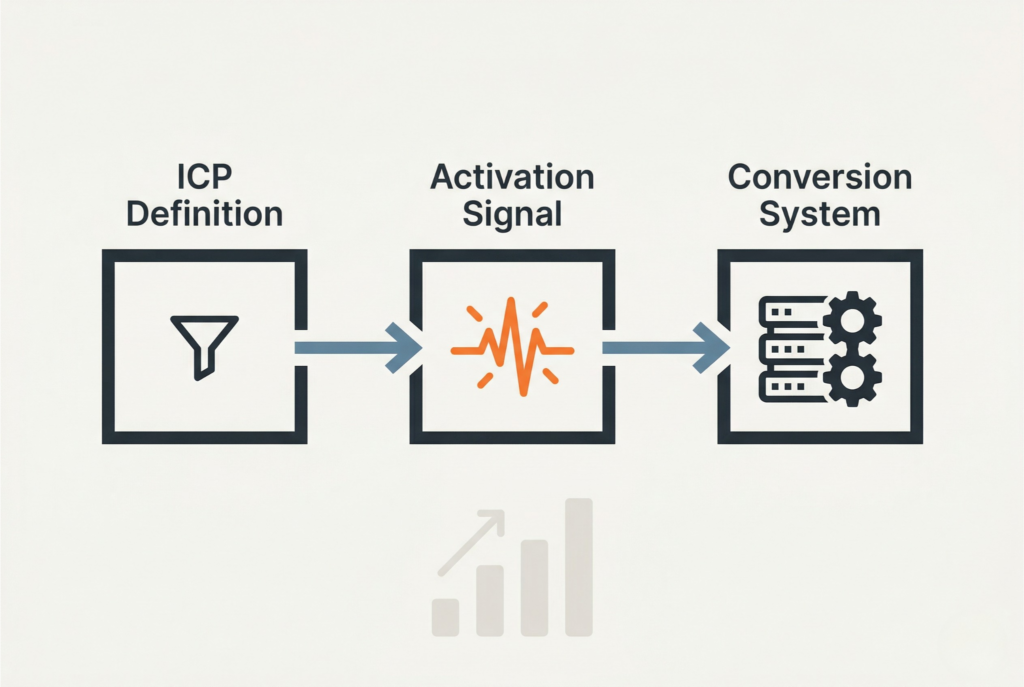
The founders who are building scalable products right now have offloaded the execution layer to AI tooling, freed their judgment for the architectural layer, and invested in product theory: a clear model of why their product creates value, who it creates it for, and what the activation signal looks like.
This is not a technology adoption story. It is a clarity story. The technology just makes it unavoidable.
At Lumeneze, we work directly with early-stage B2B teams on exactly this: building the product and GTM systems that let founders operate at the architectural level instead of staying stuck in execution. The work starts with clarity, not with tools.
How to Audit Your Own Product Practice
If you are not sure where your product practice sits, three diagnostic questions will clarify it quickly:
- Can you explain your product theory in two sentences? Not the feature set. The theory of why this product creates value for this specific customer at this specific moment.
- Do you have a defined activation moment? The specific signal that tells you a customer has experienced real value and is likely to stay. If this is fuzzy, your entire growth system is built on an unstable foundation.
- Could your team operate for two weeks without you in the product process? If the answer is no, you are still a bottleneck, not a system designer.
If any of these reveal a gap, that is the place to start. Not with a new tool. Not with a new framework template. With the underlying clarity that makes every downstream decision easier.
The PMs and founders who compound in the AI era are not the ones who learned the most AI tools. They are the ones who used the AI era as a forcing function to finally get clear on the architectural work that was always the highest-leverage part of the job.
If you are building a B2B product and want to stress-test your product theory and GTM architecture, Lumeneze works with early-stage founders on exactly this kind of structured clarity work. Start with the intro call.