

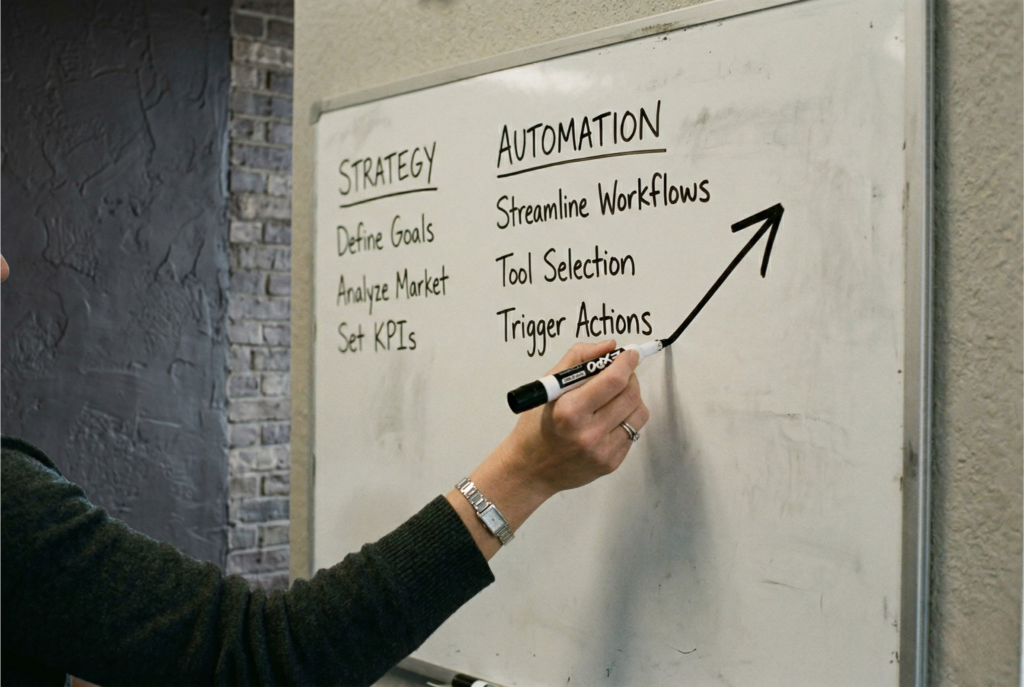
AI agents GTM strategy is the defining conversation in B2B SaaS right now. Founders are deploying autonomous systems for outreach, qualification, and pipeline management at a speed that would have seemed impossible two years ago. The tools are genuinely impressive. The results, for most companies, are not.
Gartner projects that over 40% of agentic AI projects will be abandoned by end of 2027 due to escalating costs, unclear business value, or inadequate risk controls. That number is not surprising to anyone who has watched the adoption cycle up close. The problem is almost never the technology. It is the sequencing.
AI agents are multipliers. They do not change direction. They amplify the vector that already exists underneath them. If your GTM foundation is sound, agents create compound returns. If your GTM foundation is off, agents create compound waste. Understanding this distinction is the most practical thing a B2B founder can do in 2026.
The Sequencing Mistake Most B2B Founders Make
The typical path looks like this. A founder or growth lead sees the productivity numbers around agentic outreach. Response rates up. Sales cycles shortened by 36%. Cost per opportunity down significantly. They move fast. They deploy Clay for enrichment, Smartlead or Instantly for outreach sequences, and a qualification agent to filter inbound. They go live.
Two months later, reply rate is 0.3%. They tweak subject lines. Still 0.3%. They try different send times. Still 0.3%. They add personalization tokens. Still 0.3%.
The issue is almost never any of those things. The issue is the ICP definition behind the list, and the message logic behind the sequence. Both were already wrong before the first agent was deployed. The agents just scaled the wrong play faster.
This is the AI agents GTM sequencing error: automating before clarifying. It is the most expensive mistake early-stage B2B teams make in the current environment, precisely because the tools make it so easy to move fast.
Why AI Agents GTM Success Requires a Sound Foundation
Every AI agent in your GTM stack inherits assumptions. Your ICP definition determines who the enrichment agent targets. Your value proposition determines what the outreach agent says. Your onboarding design determines whether the qualification agent surfaces the right engagement signals. Change any of those inputs and the output changes entirely.
The teams seeing real ROI from agentic GTM systems share one characteristic. They fixed the strategy layer before touching the automation layer. They answered three questions with specificity before deploying anything autonomous:
- Who exactly is this for, at both account level and persona level, with enough specificity that you could build a list of 200 companies and be confident 80% belong on it?
- Why should they stop and engage, meaning what specific, felt problem does your product or service solve that they are actively experiencing right now?
- What does the product need to do in the first session to earn continued attention, and does the current onboarding actually deliver that?
Without clear answers to all three, AI agents in your GTM stack will work exactly as designed. They will just be optimizing the wrong objective.
The Broken ICP Problem
ICP problems are the root cause of most GTM failures in early-stage B2B. They are also the hardest to see from inside the company, because the people who defined the ICP usually believe it is correct.
A common version: a founder defines ICP as “B2B SaaS companies with 10-100 employees.” This is not an ICP. It is a market segment. An ICP needs enough specificity that you can describe the problem that triggers the buying decision, the role that feels it most acutely, and the conditions that make a company ready to buy now rather than later.
When an AI agent runs outreach against a vague ICP, it reaches everyone who technically fits the criteria. The message has to be generic enough to apply to all of them. Generic messages produce generic results. And because agents can run at scale, a vague ICP gets tested against thousands of companies simultaneously, burning deliverability and wasting a long time before the pattern becomes obvious.
The fix is not a better AI agent. The fix is a sharper ICP, tested manually against 20 to 30 real conversations before any automation is introduced. This is the foundation work Lumeneze does before any GTM system is built. Manual validation first. Automation second.
The Right Order: Strategy Before Automation
The correct AI agents GTM sequence is not complicated. What makes it hard is that it requires slowing down before you speed up, which is counterintuitive in a moment when all of the tool marketing is about moving faster.
The sequence that actually works:
- Clarify ICP with specificity. Not a segment. A specific type of company, at a specific stage, with a specific trigger event that makes them a buyer right now. Validate this through conversations, not assumptions.
- Build a message that connects product to a felt problem. Not features. Not capabilities. The specific pain this buyer has today that your product resolves. Test this message manually until you see genuine engagement.
- Nail the activation moment. Whatever the first interaction is, whether a trial session, a demo, or a free audit, it needs to deliver a clear, memorable moment of value within the first contact. If it does not, fix this before automating acquisition.
- Then deploy agents. At this point, you are not gambling on whether the strategy works. You have validated it manually. You are now deploying automation to scale a motion that is already proven.
This sequence is not slower overall. It is faster to real traction. The teams that skip steps one through three spend six to twelve months optimizing automation on top of a broken foundation. The teams that do the work upfront often see genuine results within the first few months of deploying agents.
What to Fix First Before Deploying AI Agents
If you are an early-stage B2B founder evaluating agentic GTM tools right now, the most useful question to ask is not which tool to use. It is whether your strategy is ready to be scaled.
Run this audit before you deploy anything:
- Can you name three specific companies that are perfect-fit customers and explain exactly why they bought?
- Can you write one sentence that describes the problem your product solves and have a buyer immediately say “yes, that is exactly it”?
- Does your current activation flow deliver a clear moment of value in the first session, and do you have data to confirm this?
If you cannot answer all three confidently, you have strategy work to do before automation work. Harvard Business Review’s research on automation ROI consistently shows that the highest returns come from automating validated, high-signal processes, not from automating faster to find signal.
AI agents GTM strategies are only as good as the thinking underneath them. That thinking is a strategic question, not a technical one. It is the work that determines whether your automation investment compounds or collapses.
If you are working through this and want a structured framework for getting the GTM foundation right before you automate, reach out to Lumeneze or book a quick intro call. We work with early-stage B2B teams to clarify strategy, fix activation, and build growth systems that scale.