
Table of Contents
Most B2B founders believe they are executing an AI-native product strategy. In practice, most are running a 2021-era product with AI features bolted on top. The distinction matters more than almost any other strategic decision a founder will make in 2026, because the entire go-to-market motion, pricing architecture, and growth system must be designed differently depending on which type of product you actually have.
This is not a semantic argument. It is a structural one. And getting it wrong is one of the most common reasons early-stage B2B SaaS teams stall at the growth plateau.
AI-Native vs. AI-Enhanced: What’s the Real Difference?
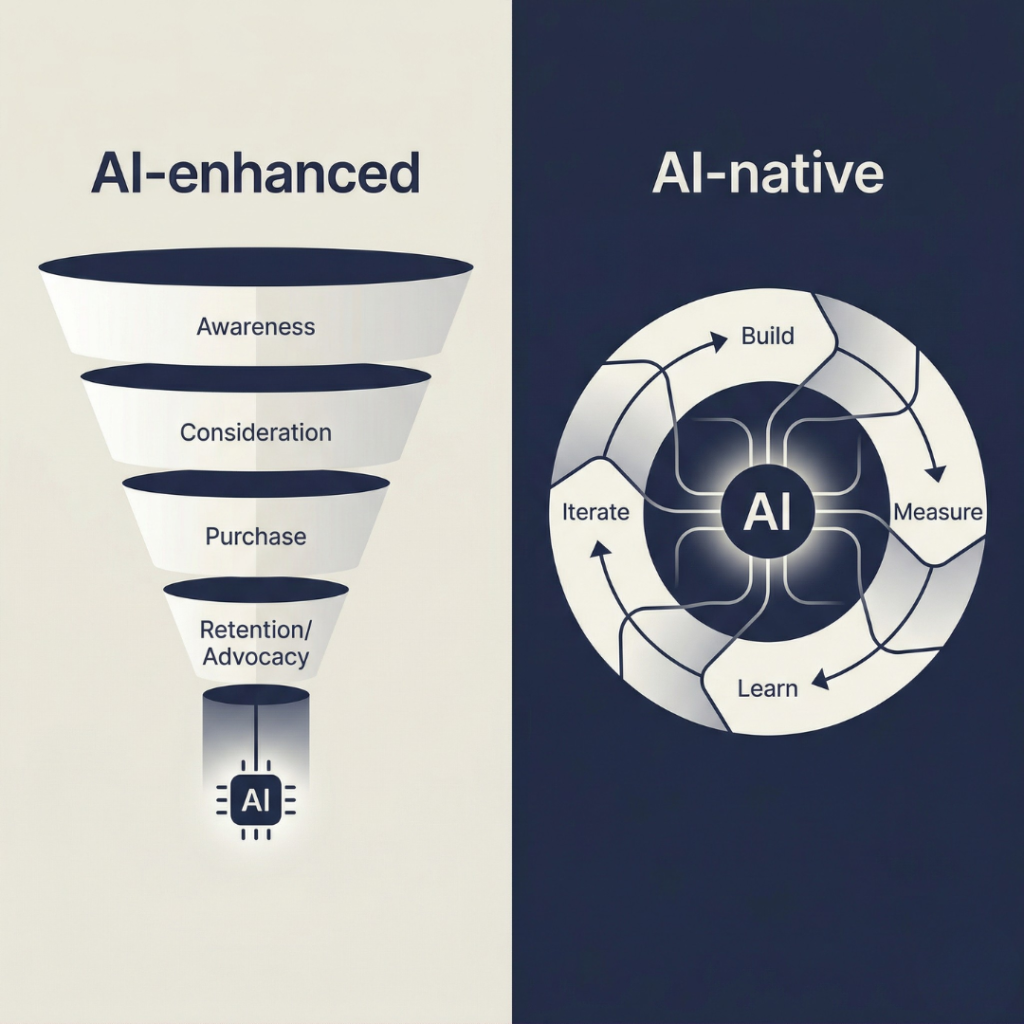
An AI-enhanced product takes a traditional product architecture and adds AI capabilities as a layer on top. The core product logic, onboarding flow, pricing structure, and GTM motion were all designed before AI was central to the product. AI was added incrementally because it was expected or because a competitor launched it first.
An AI-native product is architected from the ground up with AI as the core operational layer. The product’s value delivery, user experience, activation flow, and pricing model are all designed around what AI makes possible. The product can demonstrate meaningful value to a cold user before they configure anything, because the AI infers what the user needs and acts accordingly.
The practical test is simple: can your product deliver its core value signal to a completely cold user in under five minutes, with no demo call, no setup wizard, and no sales email?
If the answer is no, you likely have an AI-enhanced product regardless of how many AI features are in your roadmap.
Why This Changes Your GTM Completely
The AI-native product strategy is not just a product architecture decision. It rewrites the GTM motion entirely.
When a product is AI-native, the product itself qualifies, activates, and converts users. The sales motion becomes an expansion and closing function, not an explanation function. Marketing drives users to an experience that speaks for itself. The funnel collapses because fewer handoffs are needed between product, marketing, and sales.
When a product is AI-enhanced, the sales team is still carrying the explanation burden. Marketing still has to work hard to communicate value because the product does not demonstrate it on its own. Activation is slow because onboarding requires human guidance. CAC stays high because the product cannot sell itself.
This is why so many B2B teams spend heavily on positioning and messaging improvements and see marginal results. The message is not the constraint. The product architecture is.
The Three Failure Patterns We See Most Often
At Lumeneze, we work with early-stage B2B founders on product strategy and GTM architecture. Across engagements, three failure patterns appear consistently when AI-native product strategy is misaligned with the GTM motion:
1. Broken Activation
Users reach the product but never experience the core value moment. The activation flow was designed for a product that required human explanation, so users drop off before the AI has a chance to show what it can do. The sales team compensates by doing live demos for every lead, which destroys scalability.
2. ICP Designed Too Wide
The product technically serves ten different segments, so the team tries to serve all of them with the same messaging and the same GTM motion. Conversion drops across every segment because nothing is specific enough to resonate with anyone. The AI-native product strategy requires a narrower, more precise ICP because the product’s value delivery must be tuned to a specific use case to work reliably.
3. Automation Before Signal Confirmation
Teams automate outreach, onboarding sequences, and lifecycle campaigns before they have confirmed what is actually driving conversion. The automation scales the noise, not the signal. This is the most expensive mistake because it buries the real conversion constraint under operational complexity.
How to Diagnose Where You Actually Stand
The diagnostic is straightforward. Answer these four questions honestly:
- Can a new user experience the product’s core value in under five minutes with no assistance?
- Does your pricing model reflect the value the AI delivers, or does it mirror the pricing of pre-AI SaaS products in your category?
- Is your sales team primarily explaining the product, or primarily expanding and closing accounts that already understand the value?
- Has your ICP been defined based on who reaches the core value moment fastest, or based on who you assumed would be the buyer when you built the product?
If most answers reveal that the sales team is carrying the explanation burden, the activation flow requires guidance, and the ICP was set before product-market fit was confirmed, you are running a traditional GTM motion on a product that was designed to support a different one. According to ProductLed’s 2026 PLG research, the fastest-growing AI companies are those that deliver instant product value before the user makes any configuration decision, and build their entire GTM around that moment.
The Correct Sequencing for AI-Native Product Strategy
Executing an AI-native product strategy requires doing things in the right order. The most common mistake is doing step four before step one.
- Confirm the core value moment. Identify the exact interaction where a user decides the product is worth their attention. This is your activation signal. Everything else is built around reaching this moment faster and more reliably.
- Narrow the ICP to who reaches the value moment fastest. Not who you want to sell to. Not the largest market. The segment that gets to value most quickly with the least friction. That is your beachhead.
- Build the GTM motion around that specific path. Messaging, channels, sales motion, and onboarding flow should all be optimized to move the narrowed ICP to the value moment as efficiently as possible.
- Then automate. Once you have confirmed what drives conversion, build automation that scales the confirmed signal. Not before.
This sequence applies whether you are building a PLG motion, a hybrid product-led sales motion, or a more traditional enterprise sales motion. The sequencing principle holds regardless of channel or model.
What This Means for Early-Stage B2B Founders
If you are an early-stage B2B founder with an AI product, the single most valuable strategic question you can answer right now is: is your product genuinely AI-native, or is it AI-enhanced?
If it is AI-enhanced, that is not a fatal diagnosis. It is a roadmap priority. The path forward is to identify the specific product changes that would allow the product to deliver value without human assistance, then sequence the GTM work around the moment those changes are shipped.
If it is AI-native, the GTM work becomes about tuning the path to the value moment and building the expansion motion around users who have already experienced it.
In either case, the answer to inconsistent growth is almost never better messaging. It is almost always a clearer picture of where the constraint actually sits: product architecture, activation design, ICP definition, or sequencing of the GTM motion.
That clarity is where durable growth comes from. If you are working through this and want a structured outside perspective, our GTM and product strategy engagements are designed exactly for this stage. You can book a working session at calendly.com/ashikurrahaman/quick-intro.